Sick or Healthy. What’s your excuse?
When Edelman published its 2008 Trust Barometer in January the verdict was clear “trust no-one”. The lowest score of overall trust in both industry and government Edelman every recorded.
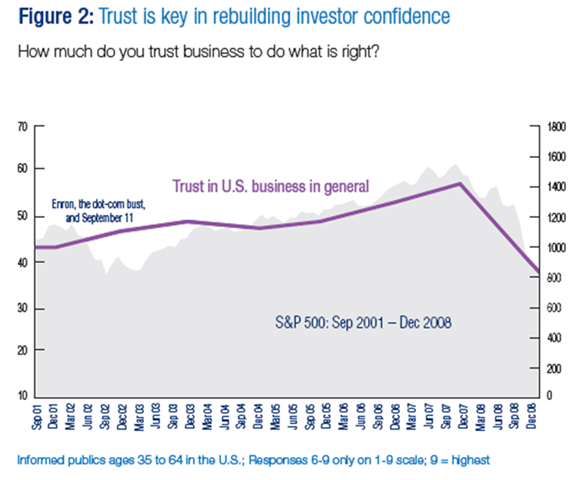
It got my attention and over the first half of 2009 I’ve discussed the issue of trust with clients many times garnering their opinions of how they feel about themselves and how their customers and suppliers feel about them.
What I hear confirms the Edelman findings. That personally and professionally we all follow the “trust and verify” philosophy of dealing with relationships these days. Trust is at the core of any relationship. With trust flagging it clearly follows that relationships are at risk. Relationships within our organizations and with key external stakeholders. Manifestations of the trust gap are sales cycles that take twice as long to close, payables that are consistently outside agree upon contracts, rumors of impending doom within the walls and overall low levels of valuable productivity.
Organizational health can be measured and trended. I advocate aggressively pursuing the development of a trust gap metric for all my clients. It’s relatively easy to establish since most of the key metrics already exist in most organizations but are seldom brought together in a single measurement. Consider that you presently collect customer satisfaction metrics, employee satisfaction metrics, vendor relationship metrics, shareholder value and some level of social media “buzz” analysis. Bringing all these individual measures of organizational health together in an index or total score allows any business to baseline health and trend it on a holistic basis.
Conventional wisdom and a plethora of research tells us that engaged employees build relationships and trust with customers and suppliers. High levels of integrity, ethics and transparency build confidence with investors and the communities we work in. All of this wisdom then begs the question, why isn’t this something we should trend?
My task for business leaders is to pay attention to the trust gap. Financial pressures are often convenient excuses for violating the trust of key stakeholders. Holding payments to suppliers beyond 60 days, violating sales agreements, paying bonuses to senior executives while the rank and file are denied merit increases are all excuses we use to violate trust slowly eroding relationships.
In the words of Peter Drucker “Business ethics assumes that for some reason the ordinary rules of ethics do not apply to business”
If this is your operating model you are in the midst of a serious trust gap.
1 Comment »
Leave a comment
About The Change Dude
Outside the blogoshpere I’m Bob Caruso, a professional change artist/Managing Partner at Orchid Black.

Most people don’t particulary like when things around them are constantly challenging their ability to walk in a straight line. I, on the other hand, love it when the status quo was 10 minutes ago. Over the past 30 years I’ve been assisting people and organizations reinvent, reinvigorate and renew themselves. It’s a blast!
On a more professional note…I bring 35 years experience in implementing large scale change as both an executive and professional consultant. Through that time I’ve carried business cards for some formidable firms including Rockwell, Price Waterhouse, Deloitte and J.D. Power and Associates. For more about my professional history visit http://www.linkedin.com/in/bobcaruso.
Visit me here to get the opinions, advice and connections you may be looking for when the string in your life gets a bit kinky.
-
Recent
- Does Innovation Remain at Risk
- AI and the Complex Sale
- The Power Play of ‘Let Me Finish’: Strategies to Foster Open Dialogue
- Navigating Life’s Unkown Journey
- Chief Digital Officer (CDO) The What’s and Who’s
- Digital Transformation:Erecting the House
- Digital Transformation: Real or Marketing Jargon?
- The Price is Right: Cracking the Code of Productivity
- Disaster Communications
- Professional Certifications: Who Cares?
- The Age of the Itinerant Professional
- Wisdom versus Knowledge in the Age of AI
-
Links
-
Archives
- January 2025 (2)
- December 2024 (1)
- November 2024 (3)
- October 2024 (3)
- September 2024 (3)
- August 2024 (4)
- July 2024 (3)
- June 2024 (2)
- May 2024 (5)
- April 2024 (4)
- March 2024 (4)
- February 2024 (2)
-
Categories
-
RSS
Entries RSS
Comments RSS
 The Change Dude's Blog
Trust is back in vogue! Relationships and trust are the “new” way to do business. We’re no longer living in the fast paced, transactional world of just a few years ago. We’ve gone back to the basic principles of business – building trust relationships – and that takes time and effort. How do you know when, if, you’ve got someone’s trust?