Branding…Does it really matter?
If your brand requires an explanation, it’s not a brand, it’s just a fictitious name.
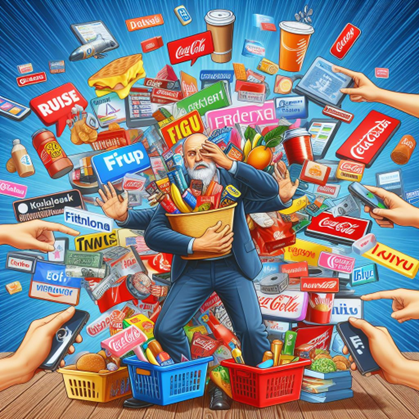
I submit that because of marketing oversaturation in every field of endeavor, unique branding has become irrelevant. I contend that the sheer volume of companies and branded products has diluted the impact of individual brands. Established brands are living off decades of saturation while new introductions get lost in the background.
Let’s consider the available data:
Number of Companies: As of 2021, there were approximately 333.34 million companies worldwide. This represents a significant increase from previous years, indicating a crowded marketplace where countless companies vie for attention. Although this number is enormous it doesn’t represent the single shingle service providers that proliferate every day so I’m adding a few more for mom and the kids, let’s call it 500 million for fun.
Branded Products and Services: While exact numbers are elusive, the proliferation of brands is evident. For instance, Nestlé alone boasts over 2,000 brands, and there are numerous examples of successful brands with numbers in their names, indicating a trend in branding strategies. Think about that for a second. One consumer company holds 2000 brands, pshaw you say, I’m not a consumer business I’m a B2B business. OK then, let’s do some quick math on that; say 50% of the 500 million or so going concerns are B2B and have just a single brand. Oops, that’s in the neighborhood of 200 million unique, or so everyone thinks, brands.
The impact of this saturation is reflected in consumer behavior and marketing effectiveness:
Consumer Trust: Over-targeting and ad saturation have been shown to damage consumer trust in brands, with 54% of UK consumers objecting to being targeted based on past online activity.
Ad Fatigue: The phenomenon of ad fatigue sets in when a target audience is bombarded with ads from the same brand, leading to decreased engagement.
Brand Relevance: Despite the challenges, 44% of consumers enjoy ads that are directly relevant, suggesting that unique branding can still resonate when executed properly.
While the data indicates a crowded marketplace with a vast number of companies and products, the relevance of unique branding is not entirely negated. Instead, the challenge lies in cutting through the noise and connecting with consumers in meaningful ways. Unique branding, when aligned with buyer interests and executed with precision, can still hold significant value and relevance.
A brand stands as the silent ambassador of a company, embodying its values, ethos, and identity. encapsulates the quintessence of what a brand should represent—a seamless connection between the product and the buyer that requires no intermediary.
Think about your own businesses branding for a moment. Does it meet the criteria as a brand? Probably not. Most branding these days is around some whimsical made-up set of letters and symbols that mean nothing to anyone other than the folks that created it.
A brand is much more than a name or a logo:
- It represents the emotional and psychological relationship a company has with its customers. Strong brands evoke a visceral response,
- It generates a feeling of familiarity and trust that resonates with the buyer on a subconscious level.
- An effective brand transcends the need for explanation because its essence is already known and felt. This immediate recognition is the hallmark of a successful brand.
The necessity for a brand to be self-explanatory also lies in the fast-paced world we live in. Consumers are bombarded with countless choices and messages every day. In such a saturated market, the ability of a brand to stand out without requiring a detailed backstory or rationale is crucial. A brand that needs to be explained is at a disadvantage, as it fails to make an instant connection with potential customers.
A brand that is self-evident is more likely to foster loyalty. When consumers understand what a brand stands for, they can align their personal values with the brand’s image. This alignment creates a strong emotional bond that is far more enduring than any rational explanation could provide. It is this bond that turns first-time buyers into lifelong customers.
Remember to consider the role of simplicity in branding. A brand that is too complex or abstract may struggle to communicate its message clearly. Simplicity in design and messaging allows a brand to be direct and powerful. A simple, yet strong brand cuts through the noise and delivers a clear message that is easy to remember and recognize.
Growing up my family would visit a butcher shop called “Meatland” no doubt there about the branding. Simple, elegant, and clear as a bell. You didn’t visit “Meatland” if you needed a tomato.
No comments yet.
About The Change Dude
Outside the blogoshpere I’m Bob Caruso, a professional change artist/Managing Partner at Orchid Black.

Most people don’t particulary like when things around them are constantly challenging their ability to walk in a straight line. I, on the other hand, love it when the status quo was 10 minutes ago. Over the past 30 years I’ve been assisting people and organizations reinvent, reinvigorate and renew themselves. It’s a blast!
On a more professional note…I bring 35 years experience in implementing large scale change as both an executive and professional consultant. Through that time I’ve carried business cards for some formidable firms including Rockwell, Price Waterhouse, Deloitte and J.D. Power and Associates. For more about my professional history visit http://www.linkedin.com/in/bobcaruso.
Visit me here to get the opinions, advice and connections you may be looking for when the string in your life gets a bit kinky.
-
Recent
- Does Innovation Remain at Risk
- AI and the Complex Sale
- The Power Play of ‘Let Me Finish’: Strategies to Foster Open Dialogue
- Navigating Life’s Unkown Journey
- Chief Digital Officer (CDO) The What’s and Who’s
- Digital Transformation:Erecting the House
- Digital Transformation: Real or Marketing Jargon?
- The Price is Right: Cracking the Code of Productivity
- Disaster Communications
- Professional Certifications: Who Cares?
- The Age of the Itinerant Professional
- Wisdom versus Knowledge in the Age of AI
-
Links
-
Archives
- January 2025 (2)
- December 2024 (1)
- November 2024 (3)
- October 2024 (3)
- September 2024 (3)
- August 2024 (4)
- July 2024 (3)
- June 2024 (2)
- May 2024 (5)
- April 2024 (4)
- March 2024 (4)
- February 2024 (2)
-
Categories
-
RSS
Entries RSS
Comments RSS
 The Change Dude's Blog
Leave a comment