A Lesson in Loyalty – The Toyota Recall
Toyota’s focus on product quality has been the benchmark for nearly every manufacturing business over the past 20 years. From it’s incredibly loyal customer base to the fans of TPS (Toyota Production System) that has been studied and replicated throughout the world Toyota has been the standard that many companies measure themselves against.
How did a giant that spawned Lean thinking and grew to outperform every major automobile company on the globe lose the trust of so many, so quickly?
Trust is fragile. Establishing the extraordinary level of trust in Toyota products has taken generations. In the virtual blink of an eye that trust has been shattered and is costing millions in lost revenue and repair related costs. Toyota is working feverishly to shore up the trust factor by doing everything in its power to resolve the quality issues. But will it be enough.
I am amazed with today’s development that The State of New York is getting “special accommodations” . Toyota has agreed to pick up and return vehicles slated for repair, provide alternative transportation such as rental cars or taxi reimbursement while owners are "unable or unwilling" to use their vehicles, and arrange for the transport of owners to their dealerships or workplaces.
Mr. Toyoda said today in Congress that “We pursued growth over the speed at which we were able to develop our people and our organization.” Full Stop!
Nearly every business can stand up and be counted in the group that can claim they have pushed growth beyond internal competency. Getting it right for customers is expensive and difficult. More importantly in 2010 getting it right is essential for survival.
Public apologies, monetary compensation, “special accommodations” fall into the bucket of risk management. Our lesson here is simple to understand but challenging to follow, that a violation of customer trust isn’t worth the quarterly revenue bump or the cost savings of not getting it right.
Perceptions of corporate reputation have undergone a significant change over the last several years, Edelman’s 2010 Trust Barometer tells us that building a reputation is as much about about honesty and trust as it is about product.
As Ben Franklin said “an ounce of prevention is worth a pound of cure.”
How’s Your Situation Awareness?
Zipping along at 600 miles per hour 100 feet off the ground in a high performing aircraft demands some serious focus. However, fixating too long on what’s coming directly at you will cause a loss of what’s going on around you. Learning to maintain an awareness of the entire situation while focusing on a specific task is crucial to survival. This skill is known as “situation awareness”

Living in an era characterized by incessant change we are constantly confronted with our changing roles as individuals, the reinvention of our companies and institutions faster than ever imagined. I read a piece last week that discussed how the length of a generation is changing from what was once nearly 20 years for the Baby Boom generation to between 6 and 7 years for what is being described as the iGeneration. We all need to keep our heads on a swivel to keep up our situation awareness.
Leaders must maintain the highest levels of situation awareness offering agile responses to the changes around them. When working with clients I routinely probe how they maintain their personal situation awareness as well as that of their organization. Most frequently the answer is “I just try to keep up with what’s in front of me and keep my team focused”. Can’t really argue with that response, but it does leave room for serious loss of situation awareness.
You may have lost your situation awareness if:
- Justifying your organization’s value to others is a full time job
- Listing your most important customers and why they value your company requires asking someone else
- Competitors in your sector know more about you than you do about them
- Engaging with customers regularly isn’t at the top of your “to-do’ list
Maintaining your situation awareness and that of everyone in the organization allows everyone to participate in making decisions about how and why change is important.
It’s a White Out
What a crazy weather week. Luckily I didn’t have a trip to the East Coast on the agenda for the week but a few of my colleagues and friends did. One of my clients marooned in Philadelphia described it as a surreal experience where he was the only person in both the office and the hotel.
Due to the extreme snow in the mid-Atlantic states everything has come to a standstill, airports are closed, schools are closed, government is closed and buildings are closed. Not so for most businesses. Many businesses are still up and running as a result of laptops, high-speed internet connections, mobile phones and virtual organizations.
Virtual organizations aren’t new. The ideas and concepts behind them have been around for 15 years but only in the recent past have they become real and functioning. People, skills, a sense of purpose and community make an organization truly hum.
Building your organization into one that functions virtually demands an environment of trust, remote tools and developed processes allowing for productivity on the move.
Weather can delay and annoy but not stop a business from moving forward in 2010.
NLP and the Average Joe
Neuro-Linguistic Programming (NLP) has been a personal interest for many years. The whole concept of using language and visual cues to positively effect relationships with others is just cool. Although I’ve never been formally trained in the art and science of NLP I find myself using the techniques constantly.
For those that don’t have any idea what NLP means the concept is simple, the use of communication, behaviors and past experience to modify what people do and feel. For the average Joe or Joanne we unconsciously use the techniques every day without realizing it.
For example, sales trainers will always tell their pupils that if you ask potential customers a series of questions with obvious “yes” answers then conclude with an offer the customer will be “programmed” to answer “yes”. Simple behavior patterning. We do the same when trying to win an argument, although often without realizing it, by stringing a series of clear facts in front of an absurd assertion. It’s the old “if-then” statement.
Personally I enjoy reading about NLP and studying the techniques to develop stronger relationships. There’s nothing more satisfying than making someone feel a little better about their day.
Just by smiling you trigger those magic mirror neurons and others will do the same. Instant rapport building and a positive connection.
Build Authentic Customer Relationships
If you think that providing the highest quality service and products to customers sits alone atop stakeholder’s lists when evaluating your company’s reputation, think again. Perceptions of corporate reputation have undergone a significant change over the last several years, Edelman’s 2010 Trust Barometer, hot off the press, tells us that building a reputation is as much about about honesty and trust as it is about product.
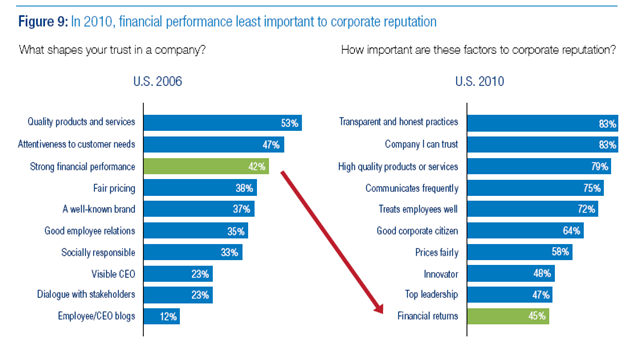
I translate honesty, trust and transparency as authenticity, when it comes to building lasting customer engagement. Authentic offers of value to customers demands being completely open and honest about what the value you bring to customers entails and more importantly, how they know they’ve received that value.
It’s not enough for your company to relate the potential value of the offering to customers but to have 3rd party experts or existing customers validate the value you bring.
Practices to Enhance Authenticity
1. Simplicity. Make doing business with your organization a snap. Easily understood offerings, clear pricing arrangements, self-service channels for those that prefer and rapid access to live-support when needed. Ensure that every contact with a customer is as “one-and-done” as possible.
2. Agility. Customers are not impressed by rigid sets of procedures to be followed when looking for answers. Build agility into every customer contact process. Unwavering rules build suspicion. Flexibility engenders trust.
3. Clarity of Expectations. Use the magic question when working with customers or stakeholders “What is your expected outcome?”. Ask the question when attempting to solve a customer’s problem to clarify quickly the organization’s ability to meet that expectation. Whether it’s developing a new product or meeting a service request begin with the customer’s end in mind. If you can’t deliver, refer to an organization that can.
While execution of these practices will vary the tenets remain the same as the underpinnings of building authentic customer relationships.
Buy-In versus Commitment
Watching the BCS National Championship game last night and hearing Alabama coach Nick Saban repeatedly refer to how his team “bought-in” to the process when he really meant to say that his players “committed” themselves to the vision, goals and activities required to achieve Championship status gave me pause. Leaders of many organizations make this vital mistake.
Building commitment is far different than obtaining buy-in, or what I believe is consensus. Gamblers buy-in to poker games, investors buy-in to start-up companies. The concept of buying-in implies that an individual is interested enough in an idea or a concept to accept the overriding premise and consent to taking part in the actions around that concept. Coach Saban’s players did far more than consent to being coached which is what buying in implies. As in many organizations that embark on strategic change getting executives and employees to buy in is incredibly easy. How can anyone argue that if a business reduces costs by 30% the bottom line will see marked improvement? It’s a fact and easy to gain consensus that a 30% cost reduction should be a goal we all strive for.
The real challenge for leaders is to build commitment for achieving that goal. Commitment that each person will go above and beyond to find ways and means to achieve the stated goal and reinforce that commitment in one another. The University of Alabama football team was committed to their goal. All the players, staff and fans went well above and beyond to attain the goal. I assure you that if the team merely “bought-in” to the goal of being National Champions that they may never have made it to Pasadena.
Change the language of leadership, remove the term buy-in from the lexicon and replace it with commitment.
Change Dude’s 2010 Predictions
Happy New Year! Twenty-ten is finally here and, as with all pundits, I felt it appropriate to make some predictions about the coming twelve months. My focused predictions that I’ve spend hours meditating on are a result of personal trend analysis coupled with some old fashioned intuition.
Developing leaders – Top Priority
Over the past decade formal leadership development has been neglected and put aside for more tangible investments by most businesses. The lack of focus on coaching and mentoring the leaders of tomorrow has come to roost. Many organizations are facing dire shortages of experienced young leaders to take the reigns as the initial thrust of boomers begin leaving their seats. Succession planning with appropriate formal programs to groom the next group of leaders will become a top issue for every organization. With growth on everyone’s mind the time to prepare leaders is now.
Resurgent New Product Development Funding
Skinny spending on “new stuff” development is over. The unfathomable sales slumps of the past 24 months have focused most businesses on reducing inventory (both hard and soft) to extremely low levels. Though spending on R&D has remained basically flat over that period I envision a significant push towards new product introductions in every sector through 2010. Economists, a.k.a fortune tellers, foresee a double dip recession before the world economy pulls itself up in mid-2011. To be prepared for the hockey stick rise in sales in 18 months funding must be in place today.
Upsurge in Virtual Companies
With our reported 10% unemployment, which everyone knows is more like 20%, their are millions of skilled, experienced Americans that will never look for a job again. This highly talented base will begin to expand the number of virtual companies within the economy. Groups of people with complementary skills will band together as individual contributors under their own banners to compete for available work within the economy. The entrepreneurial spirit will take it from there.
I wish everyone a prosperous, healthy and happy 2010!
Customer Focused Change
Few customers are very loyal these days and even fewer are willing advocates for their providers. Customers are thinking with their wallets and walking away where there is a greater perceived value for money. I’ve seen multiple studies recently that clearly identify a change in perspective for both consumers and business customers toward the requirement that value for money remain high while high service levels are maintained.
Quite a conundrum! Pay less – get more. What a strange reaction to the economic challenges of 2009. I’m certainly not surprised. I hope no one else is either.
Retaining customers is a priority. Delivering to ever increasing expectations is a significant challenge. My clients experience the rising demands of their customers daily. At the top of every executives to-do list for 2010 should be customer focused change initiatives.
Customer Focused Change
Cost reduction change, technology driven change, quality improvement change are all legitimate cases for doing things differently in your organization. Not today. The only true case for change in 2010 should be built around the customer.
Increasing levels of fragmentation are evident in customer behavior. Building lasting relationships with your customers can only occur when a provider delivers valuable differentiated experiences at every touch.
Begin customer focused change today:
1. Aggregate all your customer data to mine for trends
2. Measure organizational effectiveness in spotting new trends
3.Evaluate organizational speed and agility in addressing trends “before” negative impacts take place
4. Assess the level of responsibility ownership for customer experience throughout the organization (Does a unique function seem to own the experience?)
5. Evaluate the impact 2009 changes have had on the customer experience
6. Initiate customer focused change at the enterprise level by role modeling behavior and empowering front-line associates.
Vaccinate your organization with a renewed dedication to customers.
The Next BiG Thing
Chaos and disruption are the breeding grounds for new and exciting ideas. So in the midst of today’s economic quake which has caused incredible disruption to the lives of many I ask myself…What’s the next BiG Thing?
In the early ‘80s as a young Air Force officer who’s job was to employ state of the art electronic warfare technology I experienced the birth of Silicon Valley. Cold War strategies and tactics hinged on state-of-the-art technology. Engineers and scientists in San Jose and Santa Clara worked tirelessly to design the fastest, smallest integrated circuits. Small at that time meant a highly classified piece of equipment I used every day aboard my aircraft wielding some serious computing power, 64K, weighed 50 pounds.
Over the next 20 years the core of that technology became the basis for today’s incredibly powerful personal electronics. So what really was the BiG Thing I’m talking about that drove true economic growth, miniaturization.
I’ve been struggling with what the next major innovation, in the human, known world, would be for some time now and really don’t have a clear answer to hang onto. Although there are a few I’ve been noodling;
THE WORLD, LLC
An interesting idea. The economic changes of the past two decades have made all of planet Earth’s inhabitants highly dependent on one another for everyday existence. Monetary systems lever one another, natural resources are taken from Argentina to be manufactured into products for South Africa, US tax returns are processed in India. So is the next step one giant conglomerate that has individual countries as divisions with clear roles and contributions made made to THE WORLD, LCC? Could be? Surely there’s some benefit to just having a single Board of Directors with one ginormous balance sheet, no taxes to pay since there’s no entity to pay them to, no debt, no credit, and of course lifetime employment as an employee of WORLD, LLC. UH, OH – I think I’ve seen this movie. Not a great ending. I scratched that idea. Hopefully others have too.
Embedded Personal Multi-Media Communications
Now there’s an idea that has some legs. Every human has embedded access to everyone else, music, video, news, navigation, and knowledge by just thinking about it. WOW! The economic opportunity in this is huge. Servers to hold all the goodies, wireless technology everywhere, peripheral devices, subscriptions, maintenance fees. It’s a bonanza of potential wealth not to mention the advantages of not having to carry around a bag full of electronics. Much of this type of technology is in the works. The disruptive and intrusive force of embedded personal communication would be incredible sci-fi. Although with the introduction of smart-ID cards how far off is the next step? Personally, I’m not thrilled with this BiG idea. My preference is to keep the electronics bag around. Big brother is intrusive enough for me today. But the next generation might not feel the same connection to personal privacy.
Getting Personal
Replacing old-fashioned conversations is social networking activity. Facebook, Twitter, MySpace, LinkedIn and the hundreds of other micro-networking sites along with mobile texting have overwhelmingly consumed the imaginations and time of millions. The feeling of connection and place offered by a social network is comforting. 21st century’s ease of movement and pace of living have taken away the human, tactile sensation of the hometown. Today’s hometown is the internet. I contend that the next BiG thing is actually stepping back from the virtual hometown into a physical hometown. Closer, more social living communities. Clustering of people drawn together to live, learn, trade and share. People clustering based on preferred activities, behaviors and beliefs versus industrial necessity. Hometown’s popping up the way first generation immigrant communities form.
As a professional idea generator/problem solver I get around, look around and work to stay ahead of my clients by a step or two. 2009 was pretty slim pickings for new ideas since most big thinkers were using their innovative ideas to keep from drowning. It was a back to basics year for most of us with little time to look ahead.
2010 offers renewed opportunity to work on the next BiG thing. From my perspective 2010 will be focused on Getting Personal. Renewing trust and rebuilding communities are at the core of BiG thinking for the near future.
Here’s the bridge that connects innovation with renewal. Developing the next BiG thing for your organization isn’t about an desert island who’s only inhabitants are R&D/product development. It’s about generating an environment of trust, experimentation and feedback where innovation can thrive.
Begin 2010 by asking these 5 Key Questions;
1. Is my organization constantly questioning why things are the way they are?
2. Do associates feel safe in voicing opinions and ideas now matter the topic?
3. Are my customers involved in feeding the future agenda through an open dialogue with management and associates?
4. Are networking skills valued, nurtured and rewarded?
5. Is your organization’s eco-system being levered to allow innovative ideas to blossom from every possible locus?
If you scored below a 3 on this quick test – I challenge you to find the time to remove nose from ledger and look around at the world. You may have the next BiG thing right across the hall.
Doubletree Hotel – Surprise & Delight
Professional consultants do a tad bit of traveling, somewhere on the order of 160-200 days annually to clients throughout the world helping with sticky issues. Every day is a new opportunity for service providers to either brighten or darken our day. In most cases the latter is the case. From airlines that stuff us into their highly efficient aircraft like foam peanuts in a packing box to hotels that seem to find endless methods of charging you for items that should be bundled in the room rate.
Every so often a service provider actually delights and surprises the weary road warrior, after a service failure. This is one of those stories.
Just last week one of my colleagues had flown into John Wayne Airport for a session with our client the next day. Doing appropriate due diligence to reduce the cost of travel he found that the hotel he was booked into provided free shuttle service from the airport to the hotel, marvelous. Upon arrival he contacted the hotel via phone, unfortunately when someone did answer after dozens of rings he was put on hold then requested a shuttle. After waiting patiently for 30 minutes or so he realized the transport wasn’t coming.
Being a resourceful traveler he popped into a taxi and was whisked away to the lobby of the hotel. Finally.
Immediately after entering the lobby and approaching the front desk he was asked by the hotelier, “are you the gentleman that requested a shuttle earlier?”. The response was a resounding “yes”. An apology was quickly offered with an additional request for the cost of the cab ride. Our stalwart desk attendant then promptly reimbursed my partner for the unnecessary expense. WOW! Now that’s a service recovery.
It’s apparent that Doubletree empowers their associates to “make things right” when a service failure occurs. Bravo! Our compliments and appreciation to Doubletree for their commitment to guest service.
Recovery is the most significant loyalty builder in the service toolkit. My colleague and I were shocked and amazed by the immediate recovery putting us in a position to provide positive advocacy for both the brand and that property.
Working every day with clients that look for ways of building customer engagement we bang the drum of associate empowerment. Allow the front line do the right thing without bureaucratic restriction and loyalty will follow.
On this Thanksgiving week all road warriors are thankful to those that strive to make our travels more tolerable with an easy smile, a helping hand or a delightful service recovery.
About The Change Dude
Outside the blogoshpere I’m Bob Caruso, a professional change artist/Managing Partner at Orchid Black.
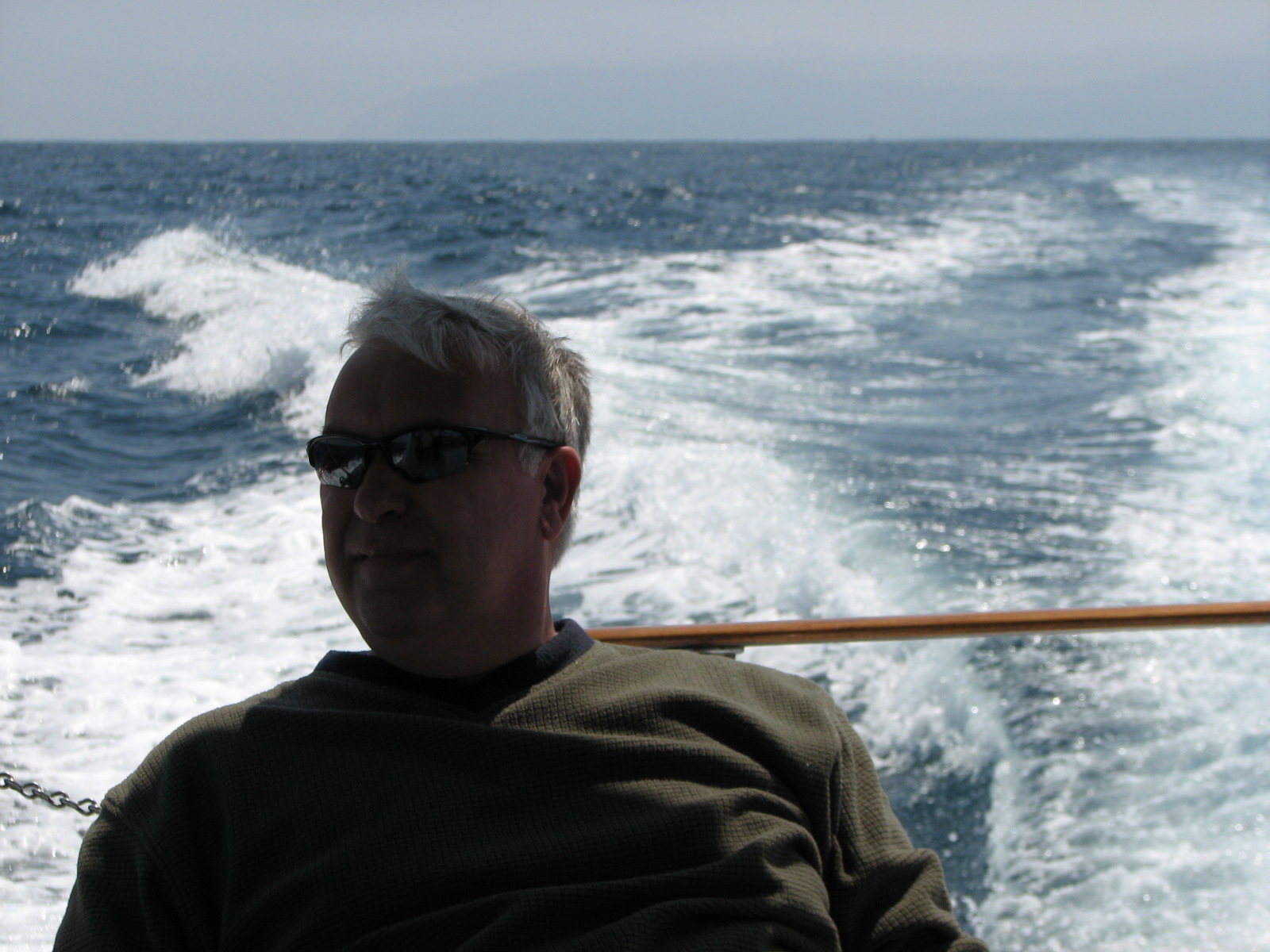
Most people don’t particulary like when things around them are constantly challenging their ability to walk in a straight line. I, on the other hand, love it when the status quo was 10 minutes ago. Over the past 30 years I’ve been assisting people and organizations reinvent, reinvigorate and renew themselves. It’s a blast!
On a more professional note…I bring 35 years experience in implementing large scale change as both an executive and professional consultant. Through that time I’ve carried business cards for some formidable firms including Rockwell, Price Waterhouse, Deloitte and J.D. Power and Associates. For more about my professional history visit http://www.linkedin.com/in/bobcaruso.
Visit me here to get the opinions, advice and connections you may be looking for when the string in your life gets a bit kinky.
-
Recent
- Does Innovation Remain at Risk
- AI and the Complex Sale
- The Power Play of ‘Let Me Finish’: Strategies to Foster Open Dialogue
- Navigating Life’s Unkown Journey
- Chief Digital Officer (CDO) The What’s and Who’s
- Digital Transformation:Erecting the House
- Digital Transformation: Real or Marketing Jargon?
- The Price is Right: Cracking the Code of Productivity
- Disaster Communications
- Professional Certifications: Who Cares?
- The Age of the Itinerant Professional
- Wisdom versus Knowledge in the Age of AI
-
Links
-
Archives
- January 2025 (2)
- December 2024 (1)
- November 2024 (3)
- October 2024 (3)
- September 2024 (3)
- August 2024 (4)
- July 2024 (3)
- June 2024 (2)
- May 2024 (5)
- April 2024 (4)
- March 2024 (4)
- February 2024 (2)
-
Categories
-
RSS
Entries RSS
Comments RSS
 The Change Dude's Blog