Are you a chicken or a pig?

Chickens and pigs, both wonderful animals that contribute to healthy, delicious breakfasts all over the world. Many years ago, when I was a young professional, one of my mentors would tell the story of breakfast. It goes like this. When you look at your morning fuel plate it’s not unusual to see bacon and eggs sitting in front of you. Consider the contribution of the chicken and the pig. The chicken is involved in the meal by offering a fresh egg. The pig is committed to its involvement.
Which are you? Do you commit to change or are you involved? The difference is stark.
Chickens use words like buy-in and alignment to affirm that they’ll work to make a change successful. Soft words with soft meanings imply that you’re sort of going to do things that contribute to the goals of the necessary change. You’ll be involved in the work, but if the work gets too hard, maybe you’ll quit on the efforts. Chickens need multiple enticements to stay engaged and really work to achieve the stated goals. Chickens will move the goal posts of the change just to declare success. Most people involved in transformation programs are chickens. It’s just human nature to be cautious and leave options open.
Pigs on the other hand are all in. They use words like commitment and must do. Pigs put everything they have into the effort without enticements because they believe in the ultimate vision. Pigs don’t let obstacles move the goal posts. Pigs persevere through the challenges, make sacrifices, and never relent. Achieving the goals of transformational change sits at the top of their to-do list. Every change effort must have leaders that represent the characteristics of the pig. These are the change agents, the visionaries, the evangelists.
Imagine if every team member was committed to a change effort versus being involved. The success rate of change programs would skyrocket. Visions would be achieved at a higher rate and returns on investment goals would be beaten.
Just a few tips to garner commitment:
- Set clear goals for the change effort. Words to describe and metrics to achieve.
- Align incentives for goal achievement.
- Communicate expectations clearly. Achieving genuine commitment requires clear communication of expectations, goals, and responsibilities.
- Build a roadmap of actions together with all the stakeholders.
- Assign accountabilities for all actions with clearly defined results.
- Measure progress frequently adjusting as needed to maintain commitment.
Coming Soon! Beware the Shiny Object
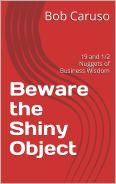
I’ve been working on a book since the start of the new year, although it’s been about 30 years in research. The content is complete and final editing is in progress with a release date within the next 30 days. So excited!
Every business leader could use a bit of advice occasionally. In this book, I share 19 and ½ Nuggets of Business Wisdom accrued from the last 35 years under the covers of all types of businesses. Whether you’re a software developer or leading a multi-million-dollar manufacturing business, this book has something for you. Every business leader looks for concise honest insights with clear actions. This book delivers.
Topics of interest include strategic decision making, organization transformation, program management, team building, customer engagement and others. With each nugget I highlights traps that can be set and practical tips to avoid them highlighted by real world case studies.
You’ll find each nugget either thought provoking or strangely familiar.
Over the next few weeks I’ll post snippets of the book to this site.
Making It Right…From the Start
Every week on HGTV Mike Holmes a burly, candid Canadian construction contractor brings to life the perils of hiring the wrong renovation contractors. He’s a skilled craftsman that prides himself on “making it right” by inspecting renovated homes and providing the homeowner with fixes to shoddy prior work. Every show ends with hugs and tears from the homeowners when the work is “done right.”
I love this show because it constantly reminds me of how important it is to give customers the best product/service available to meet their needs. This isn’t always easy. Customers look for value. Value is primarily reflected in lowest price. Lowest price may not be the “right” solution. Mike never uses low grade products, he uses the best product for the job at hand, he ensures that all work exceeds published building codes. Mike and his team of tradesmen take great pride in delivering a quality result.
In the world of large scale business transformations that I’ll proxy as IT projects the “get it right” percentage varies depending on the source. Standish Group’s most recently published Chaos Report found 32 percent of projects were considered a success. Criteria for success include: having been completed on time, on budget and with the required features and functions. Nearly one-in-four (24 percent) IT projects were considered failures, having been cancelled before they were completed, or having been delivered but never used. The rest (44 percent) were considered challenged: They were finished late, over budget, or with fewer than the required features and functions.
The July 2010 IT State of the Union survey reported traditional projects based on team size are 47% successful, 36% challenged, and 17% fail.
So basically less that half of all major IT projects are considered successful.
Mike Holmes would be apoplectic. C-Suites are disappointed. Users are frustrated and apathetic.
What seems to be the problem? In my view the primary issue is value seeking. In pursuit of getting more for less business leaders tend to go for the lowest, or near lowest logical cost for implementing major change. “Doing it right” comes into the equation in early planning and in the “lessons learned” conversations following the project. Yet during the course of the actual work of transformation the final objectives of the transformation get lost in the budget challenges.
The real cost of a failed or challenged transformation is the loss of trust in leadership. Organizational enthusiasm for the vision presented early is tainted by shortcuts taken during the process and a mediocre result.
Successful organizational change whether technical, cultural or process focused demands the investment to “doing it right” the first time. The cost and burden of “making it right” eventually becomes the responsibility of employees in the trenches that view leadership as budget conscious bumblers eroding the commitment to the next change effort to support customers, business strategy and shareholder value.
Take it from Mike Holmes just “do it right”, take pride in the outcome, get hugs all around.
Buy-In versus Commitment
Watching the BCS National Championship game last night and hearing Alabama coach Nick Saban repeatedly refer to how his team “bought-in” to the process when he really meant to say that his players “committed” themselves to the vision, goals and activities required to achieve Championship status gave me pause. Leaders of many organizations make this vital mistake.
Building commitment is far different than obtaining buy-in, or what I believe is consensus. Gamblers buy-in to poker games, investors buy-in to start-up companies. The concept of buying-in implies that an individual is interested enough in an idea or a concept to accept the overriding premise and consent to taking part in the actions around that concept. Coach Saban’s players did far more than consent to being coached which is what buying in implies. As in many organizations that embark on strategic change getting executives and employees to buy in is incredibly easy. How can anyone argue that if a business reduces costs by 30% the bottom line will see marked improvement? It’s a fact and easy to gain consensus that a 30% cost reduction should be a goal we all strive for.
The real challenge for leaders is to build commitment for achieving that goal. Commitment that each person will go above and beyond to find ways and means to achieve the stated goal and reinforce that commitment in one another. The University of Alabama football team was committed to their goal. All the players, staff and fans went well above and beyond to attain the goal. I assure you that if the team merely “bought-in” to the goal of being National Champions that they may never have made it to Pasadena.
Change the language of leadership, remove the term buy-in from the lexicon and replace it with commitment.
Change Dude’s 2010 Predictions
Happy New Year! Twenty-ten is finally here and, as with all pundits, I felt it appropriate to make some predictions about the coming twelve months. My focused predictions that I’ve spend hours meditating on are a result of personal trend analysis coupled with some old fashioned intuition.
Developing leaders – Top Priority
Over the past decade formal leadership development has been neglected and put aside for more tangible investments by most businesses. The lack of focus on coaching and mentoring the leaders of tomorrow has come to roost. Many organizations are facing dire shortages of experienced young leaders to take the reigns as the initial thrust of boomers begin leaving their seats. Succession planning with appropriate formal programs to groom the next group of leaders will become a top issue for every organization. With growth on everyone’s mind the time to prepare leaders is now.
Resurgent New Product Development Funding
Skinny spending on “new stuff” development is over. The unfathomable sales slumps of the past 24 months have focused most businesses on reducing inventory (both hard and soft) to extremely low levels. Though spending on R&D has remained basically flat over that period I envision a significant push towards new product introductions in every sector through 2010. Economists, a.k.a fortune tellers, foresee a double dip recession before the world economy pulls itself up in mid-2011. To be prepared for the hockey stick rise in sales in 18 months funding must be in place today.
Upsurge in Virtual Companies
With our reported 10% unemployment, which everyone knows is more like 20%, their are millions of skilled, experienced Americans that will never look for a job again. This highly talented base will begin to expand the number of virtual companies within the economy. Groups of people with complementary skills will band together as individual contributors under their own banners to compete for available work within the economy. The entrepreneurial spirit will take it from there.
I wish everyone a prosperous, healthy and happy 2010!
Customer Focused Change
Few customers are very loyal these days and even fewer are willing advocates for their providers. Customers are thinking with their wallets and walking away where there is a greater perceived value for money. I’ve seen multiple studies recently that clearly identify a change in perspective for both consumers and business customers toward the requirement that value for money remain high while high service levels are maintained.
Quite a conundrum! Pay less – get more. What a strange reaction to the economic challenges of 2009. I’m certainly not surprised. I hope no one else is either.
Retaining customers is a priority. Delivering to ever increasing expectations is a significant challenge. My clients experience the rising demands of their customers daily. At the top of every executives to-do list for 2010 should be customer focused change initiatives.
Customer Focused Change
Cost reduction change, technology driven change, quality improvement change are all legitimate cases for doing things differently in your organization. Not today. The only true case for change in 2010 should be built around the customer.
Increasing levels of fragmentation are evident in customer behavior. Building lasting relationships with your customers can only occur when a provider delivers valuable differentiated experiences at every touch.
Begin customer focused change today:
1. Aggregate all your customer data to mine for trends
2. Measure organizational effectiveness in spotting new trends
3.Evaluate organizational speed and agility in addressing trends “before” negative impacts take place
4. Assess the level of responsibility ownership for customer experience throughout the organization (Does a unique function seem to own the experience?)
5. Evaluate the impact 2009 changes have had on the customer experience
6. Initiate customer focused change at the enterprise level by role modeling behavior and empowering front-line associates.
Vaccinate your organization with a renewed dedication to customers.
The Next BiG Thing
Chaos and disruption are the breeding grounds for new and exciting ideas. So in the midst of today’s economic quake which has caused incredible disruption to the lives of many I ask myself…What’s the next BiG Thing?
In the early ‘80s as a young Air Force officer who’s job was to employ state of the art electronic warfare technology I experienced the birth of Silicon Valley. Cold War strategies and tactics hinged on state-of-the-art technology. Engineers and scientists in San Jose and Santa Clara worked tirelessly to design the fastest, smallest integrated circuits. Small at that time meant a highly classified piece of equipment I used every day aboard my aircraft wielding some serious computing power, 64K, weighed 50 pounds.
Over the next 20 years the core of that technology became the basis for today’s incredibly powerful personal electronics. So what really was the BiG Thing I’m talking about that drove true economic growth, miniaturization.
I’ve been struggling with what the next major innovation, in the human, known world, would be for some time now and really don’t have a clear answer to hang onto. Although there are a few I’ve been noodling;
THE WORLD, LLC
An interesting idea. The economic changes of the past two decades have made all of planet Earth’s inhabitants highly dependent on one another for everyday existence. Monetary systems lever one another, natural resources are taken from Argentina to be manufactured into products for South Africa, US tax returns are processed in India. So is the next step one giant conglomerate that has individual countries as divisions with clear roles and contributions made made to THE WORLD, LCC? Could be? Surely there’s some benefit to just having a single Board of Directors with one ginormous balance sheet, no taxes to pay since there’s no entity to pay them to, no debt, no credit, and of course lifetime employment as an employee of WORLD, LLC. UH, OH – I think I’ve seen this movie. Not a great ending. I scratched that idea. Hopefully others have too.
Embedded Personal Multi-Media Communications
Now there’s an idea that has some legs. Every human has embedded access to everyone else, music, video, news, navigation, and knowledge by just thinking about it. WOW! The economic opportunity in this is huge. Servers to hold all the goodies, wireless technology everywhere, peripheral devices, subscriptions, maintenance fees. It’s a bonanza of potential wealth not to mention the advantages of not having to carry around a bag full of electronics. Much of this type of technology is in the works. The disruptive and intrusive force of embedded personal communication would be incredible sci-fi. Although with the introduction of smart-ID cards how far off is the next step? Personally, I’m not thrilled with this BiG idea. My preference is to keep the electronics bag around. Big brother is intrusive enough for me today. But the next generation might not feel the same connection to personal privacy.
Getting Personal
Replacing old-fashioned conversations is social networking activity. Facebook, Twitter, MySpace, LinkedIn and the hundreds of other micro-networking sites along with mobile texting have overwhelmingly consumed the imaginations and time of millions. The feeling of connection and place offered by a social network is comforting. 21st century’s ease of movement and pace of living have taken away the human, tactile sensation of the hometown. Today’s hometown is the internet. I contend that the next BiG thing is actually stepping back from the virtual hometown into a physical hometown. Closer, more social living communities. Clustering of people drawn together to live, learn, trade and share. People clustering based on preferred activities, behaviors and beliefs versus industrial necessity. Hometown’s popping up the way first generation immigrant communities form.
As a professional idea generator/problem solver I get around, look around and work to stay ahead of my clients by a step or two. 2009 was pretty slim pickings for new ideas since most big thinkers were using their innovative ideas to keep from drowning. It was a back to basics year for most of us with little time to look ahead.
2010 offers renewed opportunity to work on the next BiG thing. From my perspective 2010 will be focused on Getting Personal. Renewing trust and rebuilding communities are at the core of BiG thinking for the near future.
Here’s the bridge that connects innovation with renewal. Developing the next BiG thing for your organization isn’t about an desert island who’s only inhabitants are R&D/product development. It’s about generating an environment of trust, experimentation and feedback where innovation can thrive.
Begin 2010 by asking these 5 Key Questions;
1. Is my organization constantly questioning why things are the way they are?
2. Do associates feel safe in voicing opinions and ideas now matter the topic?
3. Are my customers involved in feeding the future agenda through an open dialogue with management and associates?
4. Are networking skills valued, nurtured and rewarded?
5. Is your organization’s eco-system being levered to allow innovative ideas to blossom from every possible locus?
If you scored below a 3 on this quick test – I challenge you to find the time to remove nose from ledger and look around at the world. You may have the next BiG thing right across the hall.
Lead Change by Creating It
We’ve been at this recession thing for over 18 months now and it appears that most business executives have found their profitable operating levels. Some organizations have continuing plans to trim and right size but to all indications the chaos has subsided.
Organizational transformations that a few months ago were primarily slash and burn tactics have become implementations for a 2010 path of stability. The primary indicator of this, from my perspective, is that many of the projects my clients and I discussed in late 2009 are resurfacing 12 months today. This interesting development tells me that over the last year not a great deal of effort has been placed on business improvement. Much of the activity in 2009 focused on survival.
As a former fighter pilot I often use the world of flying as a metaphor for dealing with change. When a fast moving aircraft occupied by one person runs into an unknown challenge (on-board fire, loss of engine or any other important piece of the aircraft required for sustained flight) the rules of action are simple:
Aviate, Navigate, Communicate
Businesses were beset by some major problems in 2009, hence the pilot of those businesses focused on Aviate – keeping the aircraft/business flying. The most critical action of the triad – stay aloft and away from things that will destroy the business. Cut costs, divest drag inducing business units and keep the wings as level as possible. Aviators, like executives, tend to focus on the whole aviate process pretty intently keeping any other distractions in the background.
Executives are ready to Navigate. Determine where they are and quickly decide the best direction to head that will offer the highest chance of success. Plans are being developed, orchestrated changes being planned and goals being established. Outstanding news for Wall Street and Main Street. The business is under control and going somewhere. My experience tells me that we will see many businesses with an achievable set of goals and plans for 2010.
Aircraft under control, direction established. Now we must Communicate. Executives must begin to bring the organization into the conversation, just as pilots talk to controllers about their plans, so that appropriate support can be rendered. Here’s the challenge for 2010, aligning associates thoughts and actions with the plan. Not as easy as it sounds. Most organizations aren’t the point and shoot places they were 18 months ago. Staffs are reduced to minimal operating levels, everyone has multiple roles serving multiple goal sets. Trust in leadership is weak and the economy as a whole even weaker.
Communicating the new direction and programs that are needed to keep the business flying will fall short unless a concerted effort is put in place to bring the “crew” back together.
Change Leadership skills are mandatory for every executive.
One cannot manage change. One can only be ahead of it. In a period of upheavals, such as the one we are living in, change is the norm. To be sure, it is painful and risky, and above all it requires a great deal of very hard work. But unless it is seen as the task of the organization to lead change, the organization will not survive. In a period of rapid structural change, the only ones who survive are the change leaders.
Peter Drucker,Management Challenges for the 21st Century:
Proof…Nothing is Impossible
A vintage photograph hangs on the wall in my office, it’s there to remind me that no goal is too high to reach for.

In this photograph from 1962, President John F. Kennedy is captured attending a briefing given by Air Force Major Rocco Petrone during a tour of Blockhouse 34 at the Cape Canaveral Missile Test Annex. The men flanking President Kennedy were the pioneers of manned space flight that only 72 months later safely landed and returned 3 astronauts to earth from our first trip to the surface of the moon.
Each time I look at this photo it reminds me of the warm summer night I watched that whole moon landing things happen in grainy black and white on an 18 inch television. I was 10 years old and a space fanatic. Back then you could write to NASA and they would send you photographs of just about anything. I had a complete collection of black and white photos from every angle possible of the Saturn V, the Lunar Module, and rockets of all types. The space race was pretty important to kids back then, it was all about a goal. A goal that became a national obsession to honor a young, charismatic leader that established with clarity and confidence what the space program would accomplish.
In the midst of one of the key transformational decades in the history of the United States the adults around me struggled with Vietnam, the civil rights movement, the cold war and young adults that we’re freaking out in rebellion. Yet America set it’s sights on a goal and beat the schedule.
Over the years that came after this historic event the path of my life led me to meet and become associated with much of the space program as an adult. Defending this country as an Air Force flyer gave me the knowledge and experience to understand just how hard this success was to achieve. As an executive with Rockwell, North American Aircraft I met and worked side by side with the men that designed, built and managed the Apollo program. Not one single thing was every considered beyond doing. It was never about the problem, it was about the solution.
As we celebrate the 40th anniversary of the Apollo 11 touchdown at a time when America again is turning a page let’s remember the courage, teamwork and grit it took to make the landing a reality.
Nothing is impossible…I can prove it.
History’s Greatest Shared Goal
In the sweltering summer heat of Philadelphia in 1776 the 56 representatives of 13 British Colonies met to mutually pledge to each other our Lives, our Fortunes, and our sacred Honor.
These men were the signers of the Declaration of Independence. They developed 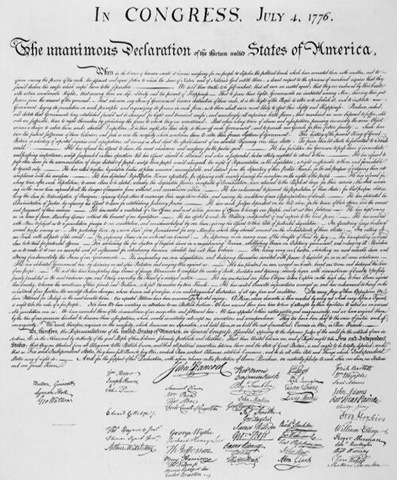 a clearly written charter that articulated the shared goals of an entire nation. The power of these goals set into motion a series of events that survive today.
Our Founding Fathers wrote the book on Change Leadership. Their collaboration through the difficult negotiations required to build the consensus for an organizational change of immense magnitude is an example to all of us today.
Leading large scale change demands bold, courageous action. Action that can only be initiated and sustained by a clear set of shared goals, the Framers had one awesome set of organizing principles and a shared goal that demanded complete commitment to success.
As we get ready to enjoy the barbeques, fireworks and general merry making that comes to these United States each July 4th it’s crucially important to remember that we, as Americans, hold a sacred trust to remain faithful to the power of embracing change in an increasingly chaotic world.
I encourage everyone to take a minute this weekend to read the text of the most historic change charter ever written http://www.ushistory.org/Declaration/document/index.htm
Happy Independence Day!
About The Change Dude
Outside the blogoshpere I’m Bob Caruso, a professional change artist/Managing Partner at Orchid Black.
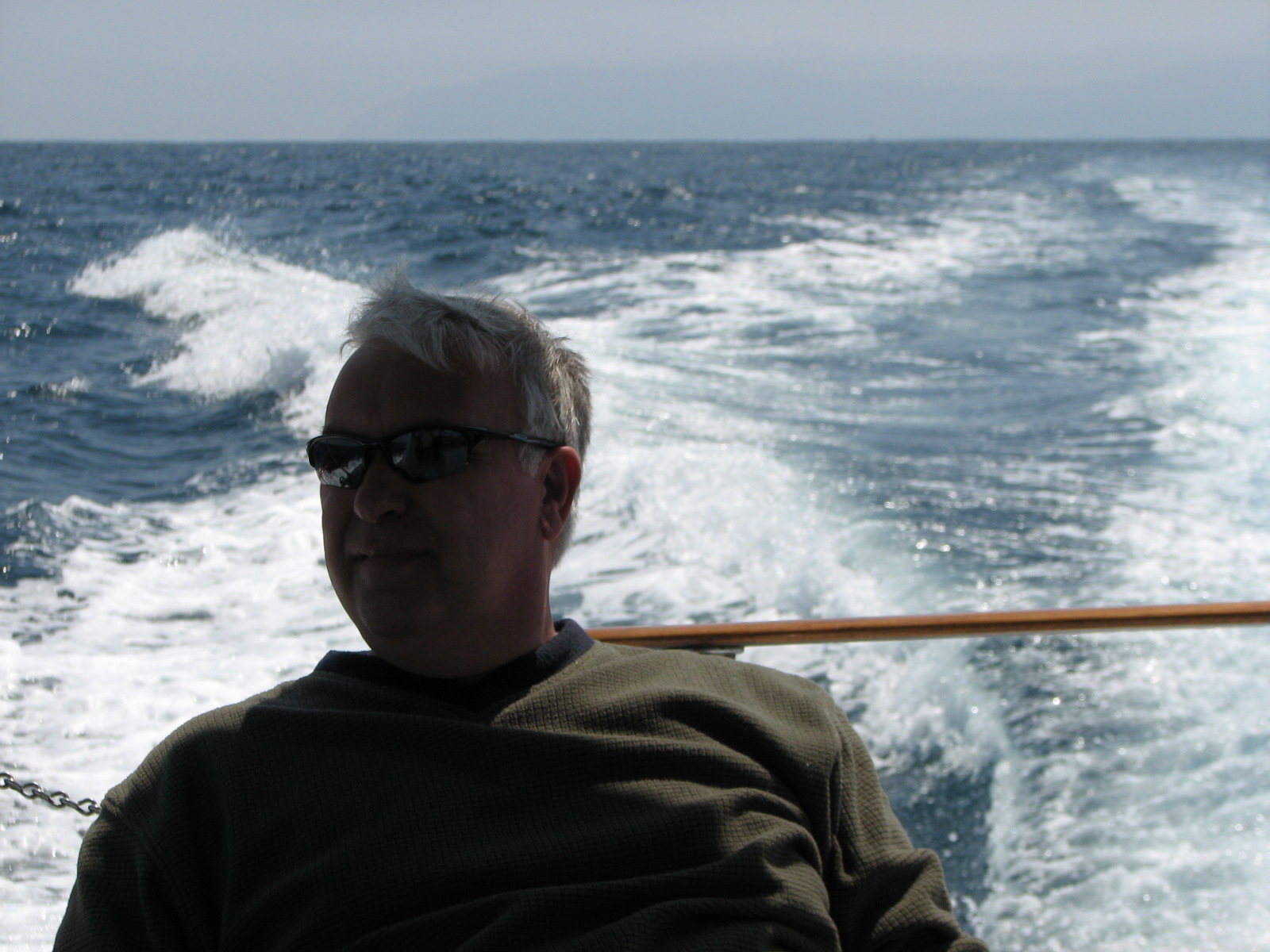
Most people don’t particulary like when things around them are constantly challenging their ability to walk in a straight line. I, on the other hand, love it when the status quo was 10 minutes ago. Over the past 30 years I’ve been assisting people and organizations reinvent, reinvigorate and renew themselves. It’s a blast!
On a more professional note…I bring 35 years experience in implementing large scale change as both an executive and professional consultant. Through that time I’ve carried business cards for some formidable firms including Rockwell, Price Waterhouse, Deloitte and J.D. Power and Associates. For more about my professional history visit http://www.linkedin.com/in/bobcaruso.
Visit me here to get the opinions, advice and connections you may be looking for when the string in your life gets a bit kinky.
-
Recent
- Does Innovation Remain at Risk
- AI and the Complex Sale
- The Power Play of ‘Let Me Finish’: Strategies to Foster Open Dialogue
- Navigating Life’s Unkown Journey
- Chief Digital Officer (CDO) The What’s and Who’s
- Digital Transformation:Erecting the House
- Digital Transformation: Real or Marketing Jargon?
- The Price is Right: Cracking the Code of Productivity
- Disaster Communications
- Professional Certifications: Who Cares?
- The Age of the Itinerant Professional
- Wisdom versus Knowledge in the Age of AI
-
Links
-
Archives
- January 2025 (2)
- December 2024 (1)
- November 2024 (3)
- October 2024 (3)
- September 2024 (3)
- August 2024 (4)
- July 2024 (3)
- June 2024 (2)
- May 2024 (5)
- April 2024 (4)
- March 2024 (4)
- February 2024 (2)
-
Categories
-
RSS
Entries RSS
Comments RSS
 The Change Dude's Blog