Build Authentic Customer Relationships
If you think that providing the highest quality service and products to customers sits alone atop stakeholder’s lists when evaluating your company’s reputation, think again. Perceptions of corporate reputation have undergone a significant change over the last several years, Edelman’s 2010 Trust Barometer, hot off the press, tells us that building a reputation is as much about about honesty and trust as it is about product.
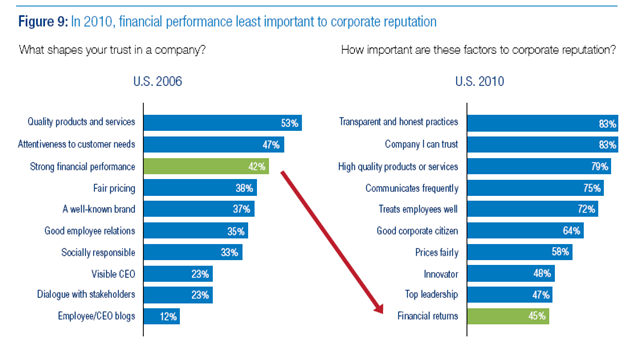
I translate honesty, trust and transparency as authenticity, when it comes to building lasting customer engagement. Authentic offers of value to customers demands being completely open and honest about what the value you bring to customers entails and more importantly, how they know they’ve received that value.
It’s not enough for your company to relate the potential value of the offering to customers but to have 3rd party experts or existing customers validate the value you bring.
Practices to Enhance Authenticity
1. Simplicity. Make doing business with your organization a snap. Easily understood offerings, clear pricing arrangements, self-service channels for those that prefer and rapid access to live-support when needed. Ensure that every contact with a customer is as “one-and-done” as possible.
2. Agility. Customers are not impressed by rigid sets of procedures to be followed when looking for answers. Build agility into every customer contact process. Unwavering rules build suspicion. Flexibility engenders trust.
3. Clarity of Expectations. Use the magic question when working with customers or stakeholders “What is your expected outcome?”. Ask the question when attempting to solve a customer’s problem to clarify quickly the organization’s ability to meet that expectation. Whether it’s developing a new product or meeting a service request begin with the customer’s end in mind. If you can’t deliver, refer to an organization that can.
While execution of these practices will vary the tenets remain the same as the underpinnings of building authentic customer relationships.
Customer Focused Change
Few customers are very loyal these days and even fewer are willing advocates for their providers. Customers are thinking with their wallets and walking away where there is a greater perceived value for money. I’ve seen multiple studies recently that clearly identify a change in perspective for both consumers and business customers toward the requirement that value for money remain high while high service levels are maintained.
Quite a conundrum! Pay less – get more. What a strange reaction to the economic challenges of 2009. I’m certainly not surprised. I hope no one else is either.
Retaining customers is a priority. Delivering to ever increasing expectations is a significant challenge. My clients experience the rising demands of their customers daily. At the top of every executives to-do list for 2010 should be customer focused change initiatives.
Customer Focused Change
Cost reduction change, technology driven change, quality improvement change are all legitimate cases for doing things differently in your organization. Not today. The only true case for change in 2010 should be built around the customer.
Increasing levels of fragmentation are evident in customer behavior. Building lasting relationships with your customers can only occur when a provider delivers valuable differentiated experiences at every touch.
Begin customer focused change today:
1. Aggregate all your customer data to mine for trends
2. Measure organizational effectiveness in spotting new trends
3.Evaluate organizational speed and agility in addressing trends “before” negative impacts take place
4. Assess the level of responsibility ownership for customer experience throughout the organization (Does a unique function seem to own the experience?)
5. Evaluate the impact 2009 changes have had on the customer experience
6. Initiate customer focused change at the enterprise level by role modeling behavior and empowering front-line associates.
Vaccinate your organization with a renewed dedication to customers.
Doubletree Hotel – Surprise & Delight
Professional consultants do a tad bit of traveling, somewhere on the order of 160-200 days annually to clients throughout the world helping with sticky issues. Every day is a new opportunity for service providers to either brighten or darken our day. In most cases the latter is the case. From airlines that stuff us into their highly efficient aircraft like foam peanuts in a packing box to hotels that seem to find endless methods of charging you for items that should be bundled in the room rate.
Every so often a service provider actually delights and surprises the weary road warrior, after a service failure. This is one of those stories.
Just last week one of my colleagues had flown into John Wayne Airport for a session with our client the next day. Doing appropriate due diligence to reduce the cost of travel he found that the hotel he was booked into provided free shuttle service from the airport to the hotel, marvelous. Upon arrival he contacted the hotel via phone, unfortunately when someone did answer after dozens of rings he was put on hold then requested a shuttle. After waiting patiently for 30 minutes or so he realized the transport wasn’t coming.
Being a resourceful traveler he popped into a taxi and was whisked away to the lobby of the hotel. Finally.
Immediately after entering the lobby and approaching the front desk he was asked by the hotelier, “are you the gentleman that requested a shuttle earlier?”. The response was a resounding “yes”. An apology was quickly offered with an additional request for the cost of the cab ride. Our stalwart desk attendant then promptly reimbursed my partner for the unnecessary expense. WOW! Now that’s a service recovery.
It’s apparent that Doubletree empowers their associates to “make things right” when a service failure occurs. Bravo! Our compliments and appreciation to Doubletree for their commitment to guest service.
Recovery is the most significant loyalty builder in the service toolkit. My colleague and I were shocked and amazed by the immediate recovery putting us in a position to provide positive advocacy for both the brand and that property.
Working every day with clients that look for ways of building customer engagement we bang the drum of associate empowerment. Allow the front line do the right thing without bureaucratic restriction and loyalty will follow.
On this Thanksgiving week all road warriors are thankful to those that strive to make our travels more tolerable with an easy smile, a helping hand or a delightful service recovery.
2010 Outlook – Creation or Destruction?
The fundamental impulse that sets and keeps the capitalist engine in motion comes from the new consumers, goods, the new methods of production or transportation, the new markets, the new forms of industrial organization that capitalist enterprise creates.
Joseph Schumpeter, in his key work Capitalism, Socialism and Democracy, originally published in 1942 argues that for capitalistic business to survive a continuing cycle of Creative Destruction must take place. Certainly the last 12 months have provided the business community with a wealth of destruction. The outstanding question is: Will 2010 offer an even greater abundance of creation?
I often describe the necessity for organization renewal to occur routinely in business to build the drive within employees to innovate and customers to advocate. 2010 demands Uber-renewal strategies. I’ve seen some of the lowest employee engagement scores since the days of Roman slavery over the past few months. Some scores well below 20% engagement. Most are hanging on to their existing jobs just long enough to move on to other opportunities.
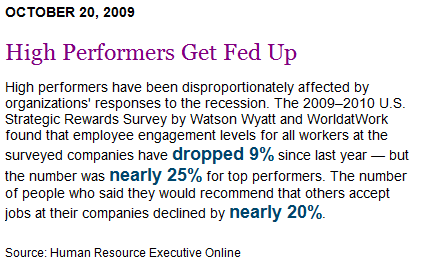
Low engagement of associates is even driven deeper as they have great concern over the organization’s commitment to its customers. Organizations that pride themselves on the highest quality products and world class customer care worry that both these areas may be impacted.
What are your renewal strategies and plans for 2010?
Human Resource groups have experienced phenomenal levels of stress dealing with layoffs, the incumbent severance servicing and flagging morale of survivors. As we enter the next phase of this economic cycle every organization needs to develop a clear path for 2010.
When planning for 2010, it is budget time for most organizations, take the offensive and build an environment where creativity and innovation can flourish.
Top 5 Renewal Focus Areas:
1. Visible, interactive leadership. Get out of the office and lead your organizations. I can not overemphasize the importance of leaders to be seen and felt by every member of the organization. This is not a time for “leadership via email”. Be present as leaders and transparent with the vision of the future.
2. Emphasize personal development. Associates need to see and experience opportunities for growth and development. Be creative in developing these opportunities across the organization. Formal training programs aren’t the only way to develop skills. Look to cross-functional “intern” programs where associates can experience work in areas of the company where their interest lies.
3. Rebuild the community. We all need a sense of place and connection to our workplace. Many of the nodal communities that were built over many years have been disrupted. Put a special focus on developing ways for new nodes to form. Bring social events back to the workplace and celebrate success, both individual and group.
4. Animate the Customer’s Voice. Bring customers front and center to the organization. Widely publicize and share customer comments, survey results, and recovery events. Put a level of excitement into the associates around the value your product of service brings into the lives of every customer.
5. Money matters, pay attention. Promotions, salary increases, bonus payments all play an important part in the emotional health of associates. When the balance sheet allows pay attention to sharing the renewal with everyone. Pay particular attention to those most negatively impacted in 2009.
Destruction is behind us…. give creation precedence.
Customer service comes to the fore
In the midst of a global economic recession the likes of which we haven’t seen since the Great Depression of the ‘30s customer service organizations have become the front line. While sales and marketing organizations are stymied by tight fisted customers despite their best efforts customer care is being put into a key position for many businesses.
Acquiring new customers is always and expensive and difficult task, in today’s world it’s damn near impossible. Holding the line by ensuring existing customers don’t defect or reject falls squarely on customer service professionals.
Just how well these stalwarts of the phone, truck rolls and keyboards perform is the difference between losing a customer or building advocacy to grow on once the economic funk lifts. Throughout the summer I’ve been living side-by-side with these champions advising clients on lifting the care experience from great to awesome. Spending time in over a dozen unique organizations that span the globe I am consistently humbled by the efforts of these professionals.

In the big scheme of delivering products and services to customers most care organizations have been relegated to necessary functions, not today. Customer care is where it’s at! Failure of a business to provide an outstanding experience on every customer touch can cost and cost dearly. Each member of the customer service team knows that every interaction is game day. They stretch their skills to the limit hamstrung by outdated tools, restrictive policies and increasingly stressful production goals. But in every case they care and care deeply.
Having consulted to customer care organizations for nearly 20 years I’ve seen the growing dependence on technology and the continuous evolution of customer service organizations. Now is the time to make the investment for the future. It’s time to give customer care professionals the respect they deserve for keeping their fingers firmly implanted in the dike despite rising waters.
Invest today in 3 key areas to keep customer care professionals fresh:
- Personal Development – offer the training and tools that will build skills
- Leadership Development – most customer service organizations are net exporters of talent to other parts of the organization. Build strong leaders that can keep customer care vibrant.
- Policy Review – Constantly review and renew customer service policies to ensure that each professional has the highest opportunity to WOW and delight at every opportunity.
Renew and refresh customer care, this investment will have extraordinary returns.
Physiology of Trust
Trust is what allows our economy to work smoothly and efficiently providing opportunities for growth and fulfillment. Our common challenge in bringing business relationships out of the proverbial tank and back into the light is renewing a level of trust with our customers, employees and shareholders.
The more I thought about this idea of organization renewal the more I sought research to guide me. In addition to the valuable experience I’ve accumulated over my years in consulting a question remained about just how this trust thing works in humans. Through the search for an answer, or at least some semblance of an idea, I came upon the relatively new science of neuroeconomics.
Neuroeconomics combines neuroscience, economics, and psychology to study how people make decisions. It looks at the role of the brain when we evaluate decisions, categorize risks and rewards, and interact with each other. From my study of the research conducted in this area my undergrad degree in Biology came in very handy.
Here’s the crux of the research, trust begets trust. OK, big enlightening finding right. Actually, yes. The result of some incredible research done by Paul Zak at the Center for Neuroeconomic Studies in Claremont, California has found that their is a physiological reason we tend to hang out with people we trust. It makes us feel better. It makes us feel good and bond because when a behavior of trust occurs between people the peptide oxytocin is released giving us an emotional lift.  That emotional lift causes us to be more open and relaxed mediating trust behavior when a decision is being made.
Ah ha! Ever wonder why we get so angry when things appear unfair? Or why we feel so good when a complete stranger offers their hand to help. Voila – oxytocin.
So how does an business organization take this really cool data and do something with it? At the core it’s about making offers that build trust. Offers of stress free service that is really stress free. Offers of discounts that are actually discounts. Offers of personal growth to employees that are made good. Each time we in the business world “make good” on a promise trust is enhanced and deeper bonding occurs, for real, through the release of oxytocin.
Unfortunately, this has not been a banner year for oxytocin release. But there is a silver lining. With all the chaos and unrest in the economy today a little bit of trust building may go a very long way.
The Change Dude’s 3 step approach to enhancing trust:
- Offer customers/employees something unexpected
- Deliver on the offer quickly without conditions a.k.a. fine print
- Repeat as often as you can
Case in point, a few years ago Bell South implements a “just ask” program requiring every customer facing employee to ask customers a simple question at the conclusion of every interaction “Was there anything else I can do for you?”
The result was a rise in overall customer satisfaction because a little offer goes a long way and sales increased based on that little question adding $100M add in first yea. Additionally, reward points were given to service people to be used to choose from catalog of goods enhancing the quality of work because they had to qualify for the opportunity and follow up with the sale.
All this good stuff happened because of a little trust, with some help, probably, from our friend oxytocin.
Knowledge, skill or luck?
Living in Surf City USA give me the opportunity to spend a lot of time in the surf. Funny thing about surfing, know how doesn’t mean you can ride a wave. It’s not often that a nubie doesn’t do weeks of face plants working to acquire the skill required to put the knowledge of surfing to work. Same principle applies to dealing with change in today’s challenging marketplace.
Many members of today’s corporate leadership teams have never experienced riding the “big surf” being presented by present challenges. The old heads that have lived through the pains of ’87, ’93 and the dot com bust are either retired or acting as consultants these days. Crucially important to preventing a major wipe out is controlled responses until some level of control can be achieved.
Translated from this somewhat lame metaphor is the need to measure response while preparing for the recovery. Managing change is always a balancing act between hardnosed drastic action and tempered empowerment. The result of being a hard guy and overcorrecting is loss of trust and commitment to future renewal actions. Using the power of the wave to propel forward motion is a far more effective approach than making severe changes that actually burn off energy you’ll need later. Look for the small changes in your organization today to augment the much larger changes made early this year. Three things to consider to retain the organizational energy you’ll need to renew in the coming months:
1. Commitment is king. Holding and building commitment of your organization to grow and succeed will pay cash dividends in the near furture.
2. Lost energy can never be regained. Draining energy from the organization is a losing proposition, for every action that negatively impacts organiational energy ensure that an equally powerful positive action is taken.
3. Celebrate every success. No matter how small the win celebrate the event openly and with great fanfare. Celebrations build energy and provide clarity that tomorrow will be another day to celebrate.
Building change skills takes more than knowing how to manage change. Start working out…
Taxes, Change and Customer Engagement
Walking through a downpour in Washington, D.C. on tax day accross from the White House I ran into a Tea Party in progress. Not your run of the mill tea party but a group of a few hundred of my fellow citizens exclaiming their displeasure with the present state of their tax bills. How cool was that? After I dried off in my client’s warm digs the thought came to me about the relationship between taxes, change and engaging your customers.
With over 500 of these tax day tea parties taking place all over the U.S. clearly our elected officials have implemented their change program at pace that has truly put their customers (us) in a state of shocked disbelief. Spewing trillions of dollars out the top of the treasury building like so many pieces of confetti has gotten citizens a little unnerved. In the world of managing change leadership has made some serious mistakes that would instantly derail any corporate change program.
Key Mistakes:
1. No clear awareness of the stakeholders readiness for change
2. Poorly designed and executed communication program.
3. Weak case for change (over 50% of Americans didn’t agree to bailing out anything let along every bank and open hand)
4. No clear vision of the future to gain commitment to the change program.
With all these holes in a strategic change program it certainly wouldn’t have even left the chocks at any of my clients let alone be in full swing. The result of a poorly managed strategic change is rapidly weakening commitment to the future state. Guess what? Commitment is flagging.
In this unique case study key stakeholders are also customers. In developing advocacy with a customer it’s critical to truly understand and analyze the practical and emotional needs required to deliver a WOW experience. As Billy Mays would say ” Where’s the WOW!” Government’s customers are far less than delighted by the present state of leadership leading to what we call in the contact center world “abandonment”. Not good. Even worst when the alienation occurs in your most valuable customers, those earning over $250,000 annually. OUCH! How many business leaders would tolerate that behavior in their organization? Not a single CEO I’ve ever met.
Often the Change Dudes are called into strategic change initiatives when they reach the state described above. Time to get back to basics and accomplish the spade work that wasn’t done before the change kicked off. If the Obama administration reached out to me as a highly experienced change dude what advise would I provide? Hmmmm….
5 Point Plan to Enhance Commitment to the US Government Strategic Change Plan
1. Develop and articulate a clear vision for the future state, specifics about what the future will look like and feel like 1, 3 and 5 years out.
2. Complete a change readiness assessment for ALL key stakeholder/customer groups to clearly identify the commitment levels of each unique group of stakeholders/customers
3. Focus commitment building efforts on the groups that need it the most, asking for feedback, acting on the feedback and enrolling support.
4. Develop and communicate a solid, bulletproof business case for the changes at hand, the exisitng case is replete with holes.
5. Make local leadership responsible and accountable for ensuring all points of view are heard, addressed and provided to senior leadership in a timely, unfiltered way.
Sounds a lot like a change leadership program with a sprinkling of customer engagement.
Change is fabulous when the end state is clear and renews the spirit of as many as possible. Change fails when a small group forces their vision on everyone.
Be your customer…Be the best
Before Saturday’s NCAA semi-final in downtown Detroit a young student-athlete playing for Michigan State who’s home town is Sterling Heights, Michigan made a slight change to his introductory bio. He changed his hometown to DETROIT. Kalin Lucas understood that the fans in Ford Field that night needed to hear their town associated with a member of the Spartan team. HE GETS IT!
Customer service training most often focuses on presenting the image and brand of the company service represents. Not really the wrong thing to do as long as the customer also works for the company. But in the case that your customers typically are not also employees it’s critically important…to be the customer. Being the customer means hearing the person asking for assistance. Hearing the tone of the their voice, the style of their communication, the severity of their concern and taking a moment to determine the best way to interact.
Listenting for key words in the early stage of a conversation with a customer helps the service provider quickly determine the preferred communication style of that partular customer. Simple techniques of using those key words and tone can quickly allow a service provider to delight the customer. Basic Jungian profiles to determine if the customer is a Director, Analytical, Socializer or Amiable. Once a provider makes this determination speaking the language of the customer is a breeze.
- DIRECTOR: Pleasant tone, business-like and confident with normal volume a relatively quick pace. (Think CEO)
- SOCIALIZER: Friendly, enthusiastic tone with an upbeat pace at a loud volume. (Think your favorite Uncle)
- AMIABLE: Understated, friendly tone with a rather slow pace and light volume. (Think librarian)
- ANALYICAL: Serious, moderate volume, moderate pace to ensure understanding. (Think CPA)
Responding to each communication style in a way that the customer relates to opens the door for understanding and exceeding expectations.
Business: Art or Science
Ever since my first days of joining the community of business leaders it has occured to me that the act of generating profit from a product or service wasn’t really something you get a degree in. Good business is done by creative people that hit a nerve with a market. Who would have thought that rocks could be considered pets? Where in the Harvard Business School curriculum is the course that helps neophytes to business learn the art of schmoozing? The whole notion that charts, graphs and numbers make a business run is ludicrous. In my experience it’s exactly the opposite. Finance is sludge that slows down the engine. Scientific business destroys the hearts and minds of everyone involved in the endeavor.
To validate my claim that good business is a product of great creativity and lots of luck is a recent study highlighted in the April 2009 HBR by a couple of Deloitte Consulting guys and a prof from the University of Texas. You can read the article but in short they evaluated companies from 1966 through 2006 finding that of the 287 alleged high-performers only one in four, that’s right 25% of the group had “remarkable” characteristics. Hence, the conclusion is that you can do everything right, according to the rules of scientific business and fall flat or just do OK and hit the market right and be a STAR.
Aha! My Five Rules for Being a Successful Business:
1. Have an idea that you love
2. Put the idea on the street and see what happens
3. Keep changing the idea until someone buys a lot of it
4. Take really good care of the people that make your idea work and the people that buy it
5. Ensure no finance executive achieves greater status in the org chart than a staff accountant, if you need real finance help buy it by the hour, you get better ideas.
It may seem a simple way to think about business. The reality is that perserverance, integrity, creatitivity and old fashioned courage make a business thrive, the rest is window dressing. Much of the consulting I’ve done over the years has been focused on assisting executive teams get back to basics. Which in large part requires them to put down the daily spreadsheets and pick up the customer satisfaction data. To move their eyes off the numbers and onto their staff.
People are the core of business and trade. Numbers are the by-product. Of the many highly successful businesses I’ve been fortunate enough to have as clients make money in-spite of management not because of it. The day-to-day work of creating, manufacturing, delivering and servicing are accomplished by heroic individuals that, more often than not, have to ignore management to keep customers happy and deliver on the brand promise.
Imagine for a moment that every C-Level executive had to service at least one customer or account every day, what a very different place most businesses would be.
About The Change Dude
Outside the blogoshpere I’m Bob Caruso, a professional change artist/Managing Partner at Orchid Black.

Most people don’t particulary like when things around them are constantly challenging their ability to walk in a straight line. I, on the other hand, love it when the status quo was 10 minutes ago. Over the past 30 years I’ve been assisting people and organizations reinvent, reinvigorate and renew themselves. It’s a blast!
On a more professional note…I bring 35 years experience in implementing large scale change as both an executive and professional consultant. Through that time I’ve carried business cards for some formidable firms including Rockwell, Price Waterhouse, Deloitte and J.D. Power and Associates. For more about my professional history visit http://www.linkedin.com/in/bobcaruso.
Visit me here to get the opinions, advice and connections you may be looking for when the string in your life gets a bit kinky.
-
Recent
- Does Innovation Remain at Risk
- AI and the Complex Sale
- The Power Play of ‘Let Me Finish’: Strategies to Foster Open Dialogue
- Navigating Life’s Unkown Journey
- Chief Digital Officer (CDO) The What’s and Who’s
- Digital Transformation:Erecting the House
- Digital Transformation: Real or Marketing Jargon?
- The Price is Right: Cracking the Code of Productivity
- Disaster Communications
- Professional Certifications: Who Cares?
- The Age of the Itinerant Professional
- Wisdom versus Knowledge in the Age of AI
-
Links
-
Archives
- January 2025 (2)
- December 2024 (1)
- November 2024 (3)
- October 2024 (3)
- September 2024 (3)
- August 2024 (4)
- July 2024 (3)
- June 2024 (2)
- May 2024 (5)
- April 2024 (4)
- March 2024 (4)
- February 2024 (2)
-
Categories
-
RSS
Entries RSS
Comments RSS
 The Change Dude's Blog