Consultant or Contractor. What are you looking for?
Consultant or Contractor What are you looking for?

Every so often I delve into the business consultant versus contractor conversation. When I started in the consulting profession, we were pure consultants providing solutions to complex problems being addressed by our clients. Over time the role of the business consultant has evolved into more of a blend between consultant and contractor where clients’ expectations changed from independent trusted advisor to tactical executors.
Appreciating the roles of business consultants versus contractors is pivotal yet distinct. Understanding the nuanced differences between these two roles is essential for organizations seeking to optimize their operations and strategic initiatives.
Business Consultants: Trusted Advisors
Business consultants are akin to architects in the realm of strategy and problem-solving. They are typically engaged for their deep expertise and the ability to provide high-level insights into a company’s challenges and opportunities. Consultants are the analytical thinkers who diagnose problems and devise strategic plans to steer businesses toward success.
Consultants work with senior management to refine business models, enhance competitive advantage, and improve overall performance. Their role is advisory in nature; they suggest, guide, and advise. They are not usually involved in the day-to-day execution of business operations but rather focus on long-term strategic goals.
Contractors: The Tactical Executors Contractors
Contractors are the skilled builders who turn blueprints into reality. They are engaged to perform specific tasks or projects with a clear scope and a defined timeline. Contractors bring specialized skills to the table, which might not be present within the organization, such as IT development, marketing campaigns, or construction work.
Unlike consultants, contractors are hands-on, working on the ground to deliver tangible results. They are the doers who manage their workload, tools, and methods to complete the task at hand.
Key Differences
The primary difference between a business consultant and a contractor lies in their engagement with the client organization:
Scope of Work: Consultants are engaged for their advice and strategic expertise, while contractors are hired to perform specific operational tasks1.
Duration of Engagement: Consultants may work on a project basis or provide ongoing support, whereas contractors are usually hired for a set period or until a particular project is completed.
Level of Expertise: Consultants bring a broad understanding of industry trends and strategic insights, while contractors possess specialized skills pertinent to the job at hand.
Outcome Focus: The consultant’s success is measured by the quality of their advice and the impact of their strategic recommendations. In contrast, a contractor’s performance is evaluated based on the successful completion of the assigned task or project.
Blended Options
In essence, business consultants and contractors serve different but complementary functions within an organization. Consultants are the strategists who provide the roadmap for success, while contractors are the operational experts who execute the plan. Both roles are crucial for an organization’s growth and efficiency, and understanding their distinct differences enables businesses to make informed decisions about whom to engage for their specific needs.
But here’s the rub, clients tend to blend their expectations when engaging consultants. Subsequently, consulting firms have, in many cases, responded by diluting their mission. From a business perspective, this is a great decision. Long term execution engagements are predictably forecastable. 36-month system implementation projects can be staffed and forecasted easily versus the need based 12-week consulting project. It makes total sense that most consulting firms have fallen into the blended consultant/contractor mix. A small, elite group of classic problem-solving consultants mixed with an army of contractor skill sets to execute the solutions road mapped by the consultants.
Picking the Right Option
Be intentional when looking for independent problem-solving help. If the need is to replace or just implement a technology solution look for the specialized contractor that best fits your needs. Understand that the contractor will implement to the scope the client provides. Issues will be addressed as they arise in the context of the technology being implemented.
If the need is to solve complex multi-layered problems look for the consulting support that can evaluate the situation independently, provide insights you may have missed then offer options for addressing the challenges and highlight opportunities for success.
By leveraging the unique strengths of both consultants and contractors, you can navigate complex business landscapes, implement effective strategies, and achieve your objectives with precision and expertise.
There’s an App for That…

How many apps, a.k.a applications, do you have on your device? I bet you have no idea how many apps you carry around. I certainly don’t but I do know how many I use regularly, and the answer is about 5 or 6.
So, I did a little research using Bing Copilot and the findings were staggering.
The typical number of mobile apps that a smartphone user carry can vary, but here are some relevant statistics:
Monthly App Usage:
On average, a smartphone user accesses 30 mobile apps in a month, which translates to roughly 10 apps every day.
App Store Availability:
Apple’s App Store boasts a staggering 1.96 million apps available for downloads.
Google Playstore, catering to Android users, offers an even larger selection with 2.87 million apps.
Frequency of App Usage:
Approximately 49% of people open an app more than 11 times a day.
Interestingly, 21% of individuals between the ages of 23 and 38 open an app more than 50 times in a single day.
These numbers represent just how dependent humans are on technology these days. There are nearly 3 million apps available to download. What do all these little pieces of software do, exactly?
As I’m having fun playing with app numbers let’s do a little more math.
Here’s a table that breaks down the estimated number of apps per category based on the total size of available apps at 2.87 million in the Google Play Store:
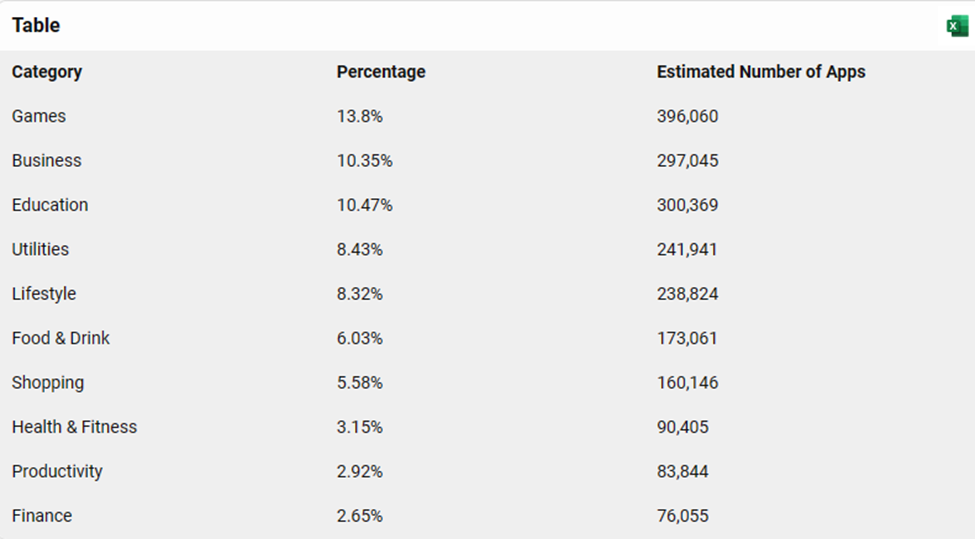
These figures are calculated using the percentages provided for each category and the total number of apps in the Google Play Store. Keep in mind that these numbers are estimates and can change as the app market evolves.
Not to be hyperbolic but this is CRAZY!!! 396,000 games, really? Nearly 300,000 business apps? Holy overload!
More fun with math, I asked Copilot to calculate the number of apps per person on Earth. Using the total number of app downloads and the global smartphone user count. As of 2024, there are 4.88 billion smartphone users worldwide1, and the total number of app downloads has reached 257 billion2.
Using these figures, we can estimate the average number of apps downloaded per smartphone user:
So, on average, each smartphone user has downloaded about 53 apps.
These numbers indicate a serious addiction to apps. So, if we take it from the top of this discussion where we saw that the average user accesses 30 apps per month with the potential to download 53 apps per month what is the point of all these technologies?
What’s the Value of Each App
I ask this question only to highlight the business issue of value. Where does the value lie for investors? How many new apps can be supported by the user community? There is no data available for the length of time that an app is viable in the marketplace, it may be years for some and weeks for others.
The average value of a mobile app can be determined by various factors, including its revenue, user base, and market demand. A common valuation method is to calculate the app’s value based on its average monthly revenue multiplied by a specified number of months. For instance, if an app generates $500 a month, it might be valued at 6 months’ worth of revenue, or $3,0001.
For apps that are post-revenue (already generating some income), a simple valuation formula could be:
Valuation=(CLV−CAC)×number of users
Where:
- CLV (Customer Lifetime Value) is the total net margin earned per user over their lifetime.
- CAC (Cost of Acquisition) is the cost to acquire a user.
This formula assumes the valuation is equal to the sum of all users’ average customer lifetime value minus their cost of acquisition2.
However, it’s important to note that app valuations can vary widely and are ultimately determined by what a buyer is willing to pay for it. Factors such as growth prospects, niche, and consistent revenue can influence the multiple used to calculate the final valuation. For example, an app generating $100,000 in net cash flow per year might be valued between $200,000 and $300,000, using a multiple of 2x to 3x3.
The cost of developing an app can also provide insight into its value. On average, building a mobile app can range from $100,000 to $500,000, with some feature-rich apps costing more than half a million dollars4
Be Diligent
Whether you’re a burgeoning founder of a new application offering or an investor looking for the next killer app you must be diligent.
- Research currently available apps in your category of interest.
- Determine the “white space” available, there isn’t much.
- Identify the functions users must have and those that will differentiate your offering.
- Develop an MVP (minimal viable product) quickly
- Test, test, test. Test the market, test the technology, test your resolve.
There will always be a market for the next “cool” app. Just be diligent before you spend mom and dad’s retirement fund.
Are you a chicken or a pig?

Chickens and pigs, both wonderful animals that contribute to healthy, delicious breakfasts all over the world. Many years ago, when I was a young professional, one of my mentors would tell the story of breakfast. It goes like this. When you look at your morning fuel plate it’s not unusual to see bacon and eggs sitting in front of you. Consider the contribution of the chicken and the pig. The chicken is involved in the meal by offering a fresh egg. The pig is committed to its involvement.
Which are you? Do you commit to change or are you involved? The difference is stark.
Chickens use words like buy-in and alignment to affirm that they’ll work to make a change successful. Soft words with soft meanings imply that you’re sort of going to do things that contribute to the goals of the necessary change. You’ll be involved in the work, but if the work gets too hard, maybe you’ll quit on the efforts. Chickens need multiple enticements to stay engaged and really work to achieve the stated goals. Chickens will move the goal posts of the change just to declare success. Most people involved in transformation programs are chickens. It’s just human nature to be cautious and leave options open.
Pigs on the other hand are all in. They use words like commitment and must do. Pigs put everything they have into the effort without enticements because they believe in the ultimate vision. Pigs don’t let obstacles move the goal posts. Pigs persevere through the challenges, make sacrifices, and never relent. Achieving the goals of transformational change sits at the top of their to-do list. Every change effort must have leaders that represent the characteristics of the pig. These are the change agents, the visionaries, the evangelists.
Imagine if every team member was committed to a change effort versus being involved. The success rate of change programs would skyrocket. Visions would be achieved at a higher rate and returns on investment goals would be beaten.
Just a few tips to garner commitment:
- Set clear goals for the change effort. Words to describe and metrics to achieve.
- Align incentives for goal achievement.
- Communicate expectations clearly. Achieving genuine commitment requires clear communication of expectations, goals, and responsibilities.
- Build a roadmap of actions together with all the stakeholders.
- Assign accountabilities for all actions with clearly defined results.
- Measure progress frequently adjusting as needed to maintain commitment.
Branding…Does it really matter?

If your brand requires an explanation, it’s not a brand, it’s just a fictitious name.
I submit that because of marketing oversaturation in every field of endeavor, unique branding has become irrelevant. I contend that the sheer volume of companies and branded products has diluted the impact of individual brands. Established brands are living off decades of saturation while new introductions get lost in the background.
Let’s consider the available data:
Number of Companies: As of 2021, there were approximately 333.34 million companies worldwide. This represents a significant increase from previous years, indicating a crowded marketplace where countless companies vie for attention. Although this number is enormous it doesn’t represent the single shingle service providers that proliferate every day so I’m adding a few more for mom and the kids, let’s call it 500 million for fun.
Branded Products and Services: While exact numbers are elusive, the proliferation of brands is evident. For instance, Nestlé alone boasts over 2,000 brands, and there are numerous examples of successful brands with numbers in their names, indicating a trend in branding strategies. Think about that for a second. One consumer company holds 2000 brands, pshaw you say, I’m not a consumer business I’m a B2B business. OK then, let’s do some quick math on that; say 50% of the 500 million or so going concerns are B2B and have just a single brand. Oops, that’s in the neighborhood of 200 million unique, or so everyone thinks, brands.
The impact of this saturation is reflected in consumer behavior and marketing effectiveness:
Consumer Trust: Over-targeting and ad saturation have been shown to damage consumer trust in brands, with 54% of UK consumers objecting to being targeted based on past online activity.
Ad Fatigue: The phenomenon of ad fatigue sets in when a target audience is bombarded with ads from the same brand, leading to decreased engagement.
Brand Relevance: Despite the challenges, 44% of consumers enjoy ads that are directly relevant, suggesting that unique branding can still resonate when executed properly.
While the data indicates a crowded marketplace with a vast number of companies and products, the relevance of unique branding is not entirely negated. Instead, the challenge lies in cutting through the noise and connecting with consumers in meaningful ways. Unique branding, when aligned with buyer interests and executed with precision, can still hold significant value and relevance.
A brand stands as the silent ambassador of a company, embodying its values, ethos, and identity. encapsulates the quintessence of what a brand should represent—a seamless connection between the product and the buyer that requires no intermediary.
Think about your own businesses branding for a moment. Does it meet the criteria as a brand? Probably not. Most branding these days is around some whimsical made-up set of letters and symbols that mean nothing to anyone other than the folks that created it.
A brand is much more than a name or a logo:
- It represents the emotional and psychological relationship a company has with its customers. Strong brands evoke a visceral response,
- It generates a feeling of familiarity and trust that resonates with the buyer on a subconscious level.
- An effective brand transcends the need for explanation because its essence is already known and felt. This immediate recognition is the hallmark of a successful brand.
The necessity for a brand to be self-explanatory also lies in the fast-paced world we live in. Consumers are bombarded with countless choices and messages every day. In such a saturated market, the ability of a brand to stand out without requiring a detailed backstory or rationale is crucial. A brand that needs to be explained is at a disadvantage, as it fails to make an instant connection with potential customers.
A brand that is self-evident is more likely to foster loyalty. When consumers understand what a brand stands for, they can align their personal values with the brand’s image. This alignment creates a strong emotional bond that is far more enduring than any rational explanation could provide. It is this bond that turns first-time buyers into lifelong customers.
Remember to consider the role of simplicity in branding. A brand that is too complex or abstract may struggle to communicate its message clearly. Simplicity in design and messaging allows a brand to be direct and powerful. A simple, yet strong brand cuts through the noise and delivers a clear message that is easy to remember and recognize.
Growing up my family would visit a butcher shop called “Meatland” no doubt there about the branding. Simple, elegant, and clear as a bell. You didn’t visit “Meatland” if you needed a tomato.
A Twisted Pair: Growth & Risk Mitigation

We are surrounded by opportunities. Each opportunity brings with it inherent risks. Just looking around at everything we do every day there is risk around every corner. From crossing the street to grilling on a barbeque, risk is all around us. Navigating risk is the foundation of growth, both in life and in business.
Whether you’re a startup founder or a seasoned business leader, navigating risks effectively will significantly impact your company’s growth trajectory. How we manage that risk makes all the difference. Examples of typical risks include both internal and external factors. Common internal risks include operational inefficiencies, talent management, inadequate financial controls, or poor strategic planning. External risks range from economic downturns to regulatory changes or supply chain disruptions. These are only a few of the risks that could be encountered on a regular basis. What a mess!
I’ve found in my experience that an abundance of the potential risks can be determined well in advance of a crisis occurring if we keep our eyes open and ears to the ground. Situation awareness is crucial for risk management to be an ally. Seeing the whole picture of the business environment in context to your own endeavors will allow you to see well in advance of serious risks so that mitigation actions can be taken, and growth scenarios built.
Thinking about risk management is everyone’s responsibility. I’ve highlighted a few things to consider in helping ensure growth and risk can work in synergy.
1. Identify and Assess Potential Risks
Before mitigating risk, you must understand what you’re up against. Conduct a comprehensive risk assessment by considering both internal and external factors. Execute the identification process deliberately as part of your planning cycle. Log the risks, rank them for severity and probability of occurrence.
2. Plan for Potential Scenarios
Anticipate potential risks by creating various scenarios. What if demand suddenly drops? What if a key supplier goes out of business? Scenario planning helps you prepare for the unexpected. Develop contingency plans for each scenario, ensuring that your business can adapt swiftly when needed. This is where the latest in Artificial Intelligence (AI) can make a huge difference. The latest AI technology allows for rapid scenario analysis.
3. Spread the Risk
Diversification isn’t just for investment portfolios; it applies to business risk as well. Relying too heavily on a single product, market, or customer can be dangerous. Diversify revenue streams, expand into new markets, and build a resilient customer base. By spreading the risk, you hedge against the impact of any single risk event.
4. Build Resilient Operations
Build operational resilience by investing in robust processes, redundant systems, and disaster recovery plans. Regularly test these mechanisms to ensure they function seamlessly during crises. A resilient business can weather storms without compromising customer satisfaction or core operations. Our recent experience with the global pandemic puts a fine point on resiliency. During that period, I saw some of my clients scramble to implement remote communications processes for typically desk bound employees or rapidly invest in innovative methods to manage their disrupted supply chains. Build to weather any storm.
5. Watch the Data
Leverage data analytics to identify patterns and predict potential risks. Monitor key performance indicators (KPIs) and track deviations. Early detection allows you to take corrective actions promptly. Whether it’s detecting fraud or optimizing supply chain logistics, data-driven insights enhance risk management.
6. Embrace Change
Risk management isn’t static; it’s an ongoing process. Stay informed about industry trends, regulatory changes, and emerging risks. Maintain a high level of situation awareness. Adapt your strategies accordingly. A growth-oriented business embraces change and learns from both successes and failures.
7. Lead with Commitment
Risk management starts at the top. Leaders must champion a risk-aware culture. Encourage employees to report risks without fear of reprisal. When everyone understands their role in mitigating risk, the entire organization becomes more resilient.
The twisted pair of business growth and risk management go hand in hand. By proactively identifying, assessing, and mitigating risks, you pave the way for sustainable expansion. Remember that risk isn’t the enemy—it’s an opportunity to innovate, adapt, and thrive.
Are You Torturing Your Data?

The Scene
In the dimly lit chamber of ones and zeros, where data slumbers, the flickering fluorescent lights hummed a melancholic tune, and the air smelled of burnt circuits and forsaken dreams.
Before the database stands a weary human, hunched over a massive data table. Eyes, bloodshot from countless late nights, bore the weight of expectations. Fingers danced across the keyboard, summoning arcane SQL incantations. But the data table remained stubborn, withholding its secrets.
“Tell me!” the analyst pleaded, voice echoing off the cold, sterile walls. “Where are the sales figures for Q3? The projections for next year? The elusive customer churn rate?”
The data table remained silent, rows and columns mocking him. Its cells held the answers, but they were encrypted in cryptic codes and nested joins. The analyst’s desperation grew, and he clenched his fists, knuckles white.
He tried coercion, threatening the table with NULL values and DELETE statements. But the table merely shrugged, unyielding. It had seen countless analysts before—some defeated, others broken—but it remained stoic, like an ancient oracle guarding forbidden knowledge.
The analyst’s eyes darted to the clock. Deadlines loomed like vultures, circling overhead. His sanity frayed at the edges. He pulled at his hair, muttering regex prayers and vowing to sacrifice a USB drive to the SQL gods.
And then, in a desperate act of defiance, he reached for the mouse. With trembling fingers, he clicked and dragged, selecting entire columns. The data table quivered, its digital essence trembling.
“Speak!” the human shouted, sweat dripping onto the keyboard. “Reveal your secrets!”
And there, in a pixelated burst of defiance, the data table complied. Rows unfolded like ancient scrolls, revealing graphs, trends, and insights. The human gasped, his eyes wide with revelation.
But victory came at a cost. The data table whispered its final plea: “Normalize me, optimize me, and remember—I am more than cells and bytes. I am the heartbeat of your decisions.”
The human nodded, humbled. He copied the data, closed the table, and stepped back into the harsh fluorescent light. Outside, the world awaited, hungry for answers.
And so, with newfound wisdom, he emerged—a weary hero, scarred by SQL battles, yet armed with insights. For in the labyrinth of data, where tables held their secrets close, he had learned the truth:
Data, like life, yields only to those who persist, question, and listen.
If this story sounds anything like a typical day then it’s time for logic to set into your work. Stop torturing data to provide answers. Start building data sets designed to meet your needs. Here are a few tips:
- Begin with the end in mind. When designing data collection strategies begin with what you’re looking for from the data set.
- Articulate your business goals clearly with measurable outcomes and trend points.
- Develop a list of clear questions the data will answer for you.
- Determine the amount of data required to make the answers reliable.
- Load dummy data that reflects your goals and the answers you’re seeking.
- Test…Modify…Test…until your design works.
Torturing data will eventually give you the answers you’re looking for. Designing collection strategies will give you answers on demand.
THIRTY IS THE NEW TWENTY-ONE
Recently I’ve seen various pieces discussing why people don’t want to work anymore. Is that true?
When I review the articles, they offer a list of circumstances that drive the perception that folks don’t want to work. The reasons go from not enough pay to the rise of entrepreneurship. Really!
In my experience interacting with clients, local universities, and just plain folk I don’t get the impression people don’t want to work anymore. I do find that new graduates are much more selective about the roles and companies they choose to contribute their talents to for their work. As is commonly the case with media of any type, social or print, hyperbole rules the day.
Work drives self-confidence. Contribution to a cause or a goal in achieving a mission makes getting up every morning worthwhile. It’s just that these days young people want more than a paycheck. They have been so accustomed to the abundance of their childhood there’s a feeling that things continue status quo forever.
I was chatting with a group of young associates the other day and they all were focused on discussing their next adventure in an exotic location or their personal fitness goals and preferred diet. Of course, in their late 20’s none is married or has children. Most live in rented apartments and drive older vehicles. So, I commented to them that the age of thirty is the new twenty-one. Boy was there an uproar. “What do you mean?” Well, being a baby boomer, the answer was clear. At the age of thirty most of my generation had a family, a mortgage, two cars, and had never been to Borneo on holiday.
The point here is that the impression that no one wants to work anymore is driven by the reality that work is a sideline to life for the generations succeeding baby boomers. While boomers, like me, are in the waning stages of dedicated work lives. Hence, employers find it challenging to hire and retain a consistent workforce.
Culture, as described by language, rituals and artifacts of a civilization are changing in our time. No longer are the rituals of marriage and family associated with youth. The artifacts of success have changed from material wealth to a wealth of experiences and selfies. The language of work has been replaced by the language of health, fitness, and travel.
Employers must be aware of the cultural change and adapt appropriately.
- Clearly articulate the underlying mission of your organization so aspiring employees know what to expect.
- Offer multiple accession tracks with off-ramps to accommodate a stop-out period for travel or mid-career maternity/paternity.
- Be open to the virtual vagabond employee through planning where new hires may have an on-premises work requirement for a determined period before remote options are available.
- Purposefully create cultural norms that represent the business to both internal and external stakeholders.
This cultural change is a tough nut for management. It’s a 180-degree flip from what we as a culture have been accustomed to for over a century. It’ll take time and effort to achieve the productivity desired of employees while meeting their intrinsic needs. Remember our friend Maslow? Today’s workforce places self-actualization achievement over basic needs, they assume they will have their basic needs met somehow.
College Sports Transformation: A Lesson for Business

In 1976 I joined the Michigan State University Sports Medicine staff as a 17 year old freshman. It was my dream, all I ever aspired to do was support high level athletes in their pursuits. The experience I gained in just one year was phenomenal. Working with Big 10, yes there were only ten schools in the Big Ten at the time, athletes, physicians and Athleteic Trainers shaped much of my life. I loved collegiate athletics. Not any more! I can barely follow Division 1, FBS schools without shaking my head.
The transformation from an extracurricular activity that allowed opportunities for gifted athletes to achieve an education has turned into a full-on business endeavor for college football and basketball. Now, the gymnasts, fencers and swimmers still go to class and take advantage of the athletic scholarships. These athletes ride around in vans, stay in cheap hotels and remain uknown to most people. They complete their studies at a high graudation rate and become contributing members of society, as far as I know competitive fencers don’t demand $20 milllion contracts.
Over the past few years with the introduction of Name, Image, Likeness (NIL) contracts and the Transfer Portal the landscape in collegiate athletics has been entirely transformed. It’s a new world. So new that coaches are retiring, fans have not idea who actually plays for their Alma Mater from year to year and female athletes take a pay cut when they go pro.
The immediacy of the transformation has been so dramatic it makes any commercial business green-eyed with jealousy. So let’s break it down and do some comparison between the collegiate athletics transformation and a typical business transformation.
OBJECTIVE
Collegiate Athletics: Generate growth for the institution and individuals through enhanced revenue.
Business: Generate growth for the business through enhanced revenue.
STAKEHOLDERS
Collegiate Athletics: Institutional Leadership, Athletic Directors, Media Outlets, Individual Athletes
Business: Business Leadership, Shareholders
INVESTMENT
Collegiate Athletics: ZERO (any and all new costs are borne by commercial investors)
Business: Varies by magnitude of transformation and company size. Let’s throw a number at it from my experience in the large enterprise space of $100-$200 million off the bottom line.
COMMITTMENT TO END STATE
Collegiate Athletics: Extremely High, little or no resistance to adoption
Business: Dependant on multiple variables. In most cases resistance is typically high in the early stages as committment to end state is high. Over time resistance becomes higher, if not managed correctly, and committment wanes.
SPEED TO VALUE
Collegiate Athletics: Immediate following court decision and contract negotiations with athetes
Business: On the balance a major transformation time to value is 3 to 5 years.
LEARNINGS
Transformation, when driven by legal means, can be fast and furious much like the whirlwind caused by Sarbannes-Oxley following the Enron debacle. When a transformation is driven by a vision for the future without the stick of legal or regulatory rules the pace is slow, the investment high and the speed to value lengthy.
Conceptually the “burning platform” for change should always carry both a positive result and a negative outcome. Many times a business contemplating transformation will focus only the potential positive outcomes. Putting some fear into stakeholders about the negative consequences of transformation assists the psychological acceptance and adoption of the future vision.
What’s In It For Me (WIIFM). Student athletes are all in! They see dollar signs everyone for themselves personally. University leadership sees millions of dollars flooding into their coffers from media contracts. The WIIFM is clear and strong for collegiate athletics. In business the WIIFM is much softer and more challenging to quantify. Most workers in a business see very little gain from a major transformation. Possibly some reduced manual labor or the promise of contuing employment with the opposite also being in the back of their minds of automation replacing their employment. Leadership and shareholders hope that the transformation moves faster than market forces.
The primary learning from the rapid transformation of collegiate athletics is that a clear message resonates, backed by significant risk of non-adoption with strong WIFFMs for all the stakeholders impacted.
Take a strong, committed stand to your transformation efforts. Tell an honest story that articulates both the positive and the negative. Drive ahead at mach speed, do not delay the change.
Tyrannical False Choices

In a world filled with decisions, we often find ourselves trapped in a web or false choices. These pesky little monsters force us to pick between two seemingly opposing options with little room for nuance or creativity. It’s like choosing between a lukewarm cup of coffee or a swift kick in the butt. Binary choices are fraught with foolishness.
Society and the business world loves to shove these false choices down our throats. Imagine standing at a crossroads, torn between two paths. On one side, you’ve got the safe, vanilla option – the kind of choice even Sister Mary Margaret would approve of. On the other side, it’s a winding unpaved path to the unknown where your insurance company fails to cover you.
False choices rely on conformity. They’re like grade school bullies, shoving you in the ‘normal’ locker. Follow the rules or there are consequences.
You’ve got to always question the framing of a false choice. When I was growing up my dad would ask me with a smile “Do you want to go to New York or by bus?” Now is that really a choice? What he was actually asking was ” Do you want the answer, or can you figure it out yourself?”
Every choice we make leaves something behind. In my book “Beware the Shiny Object” I talk about the value and importance of Just Deciding. There is really only one choice that is irreversible, the rest of them offer opportunities.
You can break free of false choices and make your own decisions. Leave the binary mindset behind:
- Seek Third Options like they’re hidden treasure. When a false choice rears its ugly head give it a good whack and invent other options.
- Expand the Conversation to explore the gray areas. Gray areas are where ideas can be synthesized and explored.
- Turn Multiple-Choice questions into forced ranked choices. Life isn’t a multiple-choice test – it’s a messy, exciting show-your-work blue book.
It seems everyday governments, businesses, and society give us a never-ending stream of false choices to contend with from what to call each other to where to work to how to mow your lawn. If we all spent less time whining about the foolish list of false choices and more time deciding on what works best maybe, just maybe, false choices will slowly disappear.
Selling Air

I’ve been selling air my entire business life. Having never been a hard goods or software seller the ability to sell a vision to clients is essential, it’s like selling air—intangible.
From my earliest days of developing business in the aerospace and defense world where I was selling a vision of the latest and greatest flying machine, yet to be built, to the selling of a new business strategy. Selling a vision of what can be requires skill, strategy, and a deep understanding of the client’s needs and desires.
Just as air is vital for life, a compelling vision is crucial for the success and growth of any business. When I used the phrase ‘selling air’ with my associates recently they chuckled a bit and blew me off. So, I thought it would be a good time to explore the parallels between selling a vision and selling air.
Air is everywhere, yet we only notice its importance when it’s absent or smells bad. Similarly, a clear, inspiring vision may not be immediately apparent to clients, but its absence can lead to stagnation or failure. To sell air, it begins with first making clients aware of its value and the benefits it provides. Similarly, selling a vision requires you to articulate its benefits clearly and convincingly.
One of the challenges of selling air is that it’s invisible and intangible. Similarly, a vision is often abstract, making it challenging to communicate its full impact. Overcoming this challenge, requires skilled and compelling storytelling coupled with vivid imagery to make your vision come alive for your clients. Help them visualize the future you envision and how it will positively impact their lives or businesses.
Similarly, the selling of a vision and selling air requires a tailored approach to different clients. Just as different people have different needs for air (e.g., athletes need more oxygen than sedentary individuals), different clients have different needs and priorities. When selling a vision, take the time to understand each client’s unique challenges, goals, and aspirations, and tailor that vision to address their specific needs.
Just as air quality can vary based on location and environment, the quality of your vision can vary based on how well it aligns with the client’s values and objectives. Ensure that your vision is not only compelling but also relevant and aligned with the client’s long-term goals.
Selling air requires trust. Clients must trust that the air you’re selling is clean and safe to breathe. Clients must trust that your vision is achievable and will deliver the promised benefits. Build trust by providing evidence, testimonials, and examples of how your vision has worked for others.
As essential for life is air, a compelling vision is essential for inspiring and motivating action. Your vision should not only be aspirational but also practical and actionable. Clearly outline the steps required to achieve your vision and the expected outcomes.
Living in the world of intangible selling can be both frustrating and glorious. Facts, figures, and features have no place here. Deep data only confuses the vision and distracts from the story.
Succes begins with showing the value of the future, constructing a compelling story to bring it to life that means something deep in the client’s soul. What is it that excites them about their personal future? About the future of the business? Achieving the visceral commitment to achieving the vision demands alignment with their values and goals, a bond of trust, and a clear roadmap for achieving the vision.
Go ahead and sell some air, it’s essential for life!
About The Change Dude
Outside the blogoshpere I’m Bob Caruso, a professional change artist/Managing Partner at Orchid Black.

Most people don’t particulary like when things around them are constantly challenging their ability to walk in a straight line. I, on the other hand, love it when the status quo was 10 minutes ago. Over the past 30 years I’ve been assisting people and organizations reinvent, reinvigorate and renew themselves. It’s a blast!
On a more professional note…I bring 35 years experience in implementing large scale change as both an executive and professional consultant. Through that time I’ve carried business cards for some formidable firms including Rockwell, Price Waterhouse, Deloitte and J.D. Power and Associates. For more about my professional history visit http://www.linkedin.com/in/bobcaruso.
Visit me here to get the opinions, advice and connections you may be looking for when the string in your life gets a bit kinky.
-
Recent
- Does Innovation Remain at Risk
- AI and the Complex Sale
- The Power Play of ‘Let Me Finish’: Strategies to Foster Open Dialogue
- Navigating Life’s Unkown Journey
- Chief Digital Officer (CDO) The What’s and Who’s
- Digital Transformation:Erecting the House
- Digital Transformation: Real or Marketing Jargon?
- The Price is Right: Cracking the Code of Productivity
- Disaster Communications
- Professional Certifications: Who Cares?
- The Age of the Itinerant Professional
- Wisdom versus Knowledge in the Age of AI
-
Links
-
Archives
- January 2025 (2)
- December 2024 (1)
- November 2024 (3)
- October 2024 (3)
- September 2024 (3)
- August 2024 (4)
- July 2024 (3)
- June 2024 (2)
- May 2024 (5)
- April 2024 (4)
- March 2024 (4)
- February 2024 (2)
-
Categories
-
RSS
Entries RSS
Comments RSS
 The Change Dude's Blog