Lead Change by Creating It
We’ve been at this recession thing for over 18 months now and it appears that most business executives have found their profitable operating levels. Some organizations have continuing plans to trim and right size but to all indications the chaos has subsided.
Organizational transformations that a few months ago were primarily slash and burn tactics have become implementations for a 2010 path of stability. The primary indicator of this, from my perspective, is that many of the projects my clients and I discussed in late 2009 are resurfacing 12 months today. This interesting development tells me that over the last year not a great deal of effort has been placed on business improvement. Much of the activity in 2009 focused on survival.
As a former fighter pilot I often use the world of flying as a metaphor for dealing with change. When a fast moving aircraft occupied by one person runs into an unknown challenge (on-board fire, loss of engine or any other important piece of the aircraft required for sustained flight) the rules of action are simple:
Aviate, Navigate, Communicate
Businesses were beset by some major problems in 2009, hence the pilot of those businesses focused on Aviate – keeping the aircraft/business flying. The most critical action of the triad – stay aloft and away from things that will destroy the business. Cut costs, divest drag inducing business units and keep the wings as level as possible. Aviators, like executives, tend to focus on the whole aviate process pretty intently keeping any other distractions in the background.
Executives are ready to Navigate. Determine where they are and quickly decide the best direction to head that will offer the highest chance of success. Plans are being developed, orchestrated changes being planned and goals being established. Outstanding news for Wall Street and Main Street. The business is under control and going somewhere. My experience tells me that we will see many businesses with an achievable set of goals and plans for 2010.
Aircraft under control, direction established. Now we must Communicate. Executives must begin to bring the organization into the conversation, just as pilots talk to controllers about their plans, so that appropriate support can be rendered. Here’s the challenge for 2010, aligning associates thoughts and actions with the plan. Not as easy as it sounds. Most organizations aren’t the point and shoot places they were 18 months ago. Staffs are reduced to minimal operating levels, everyone has multiple roles serving multiple goal sets. Trust in leadership is weak and the economy as a whole even weaker.
Communicating the new direction and programs that are needed to keep the business flying will fall short unless a concerted effort is put in place to bring the “crew” back together.
Change Leadership skills are mandatory for every executive.
One cannot manage change. One can only be ahead of it. In a period of upheavals, such as the one we are living in, change is the norm. To be sure, it is painful and risky, and above all it requires a great deal of very hard work. But unless it is seen as the task of the organization to lead change, the organization will not survive. In a period of rapid structural change, the only ones who survive are the change leaders.
Peter Drucker,Management Challenges for the 21st Century:
2010 Outlook – Creation or Destruction?
The fundamental impulse that sets and keeps the capitalist engine in motion comes from the new consumers, goods, the new methods of production or transportation, the new markets, the new forms of industrial organization that capitalist enterprise creates.
Joseph Schumpeter, in his key work Capitalism, Socialism and Democracy, originally published in 1942 argues that for capitalistic business to survive a continuing cycle of Creative Destruction must take place. Certainly the last 12 months have provided the business community with a wealth of destruction. The outstanding question is: Will 2010 offer an even greater abundance of creation?
I often describe the necessity for organization renewal to occur routinely in business to build the drive within employees to innovate and customers to advocate. 2010 demands Uber-renewal strategies. I’ve seen some of the lowest employee engagement scores since the days of Roman slavery over the past few months. Some scores well below 20% engagement. Most are hanging on to their existing jobs just long enough to move on to other opportunities.
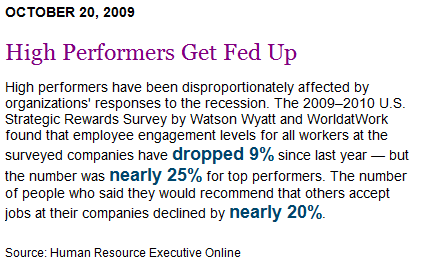
Low engagement of associates is even driven deeper as they have great concern over the organization’s commitment to its customers. Organizations that pride themselves on the highest quality products and world class customer care worry that both these areas may be impacted.
What are your renewal strategies and plans for 2010?
Human Resource groups have experienced phenomenal levels of stress dealing with layoffs, the incumbent severance servicing and flagging morale of survivors. As we enter the next phase of this economic cycle every organization needs to develop a clear path for 2010.
When planning for 2010, it is budget time for most organizations, take the offensive and build an environment where creativity and innovation can flourish.
Top 5 Renewal Focus Areas:
1. Visible, interactive leadership. Get out of the office and lead your organizations. I can not overemphasize the importance of leaders to be seen and felt by every member of the organization. This is not a time for “leadership via email”. Be present as leaders and transparent with the vision of the future.
2. Emphasize personal development. Associates need to see and experience opportunities for growth and development. Be creative in developing these opportunities across the organization. Formal training programs aren’t the only way to develop skills. Look to cross-functional “intern” programs where associates can experience work in areas of the company where their interest lies.
3. Rebuild the community. We all need a sense of place and connection to our workplace. Many of the nodal communities that were built over many years have been disrupted. Put a special focus on developing ways for new nodes to form. Bring social events back to the workplace and celebrate success, both individual and group.
4. Animate the Customer’s Voice. Bring customers front and center to the organization. Widely publicize and share customer comments, survey results, and recovery events. Put a level of excitement into the associates around the value your product of service brings into the lives of every customer.
5. Money matters, pay attention. Promotions, salary increases, bonus payments all play an important part in the emotional health of associates. When the balance sheet allows pay attention to sharing the renewal with everyone. Pay particular attention to those most negatively impacted in 2009.
Destruction is behind us…. give creation precedence.
Customer service comes to the fore
In the midst of a global economic recession the likes of which we haven’t seen since the Great Depression of the ‘30s customer service organizations have become the front line. While sales and marketing organizations are stymied by tight fisted customers despite their best efforts customer care is being put into a key position for many businesses.
Acquiring new customers is always and expensive and difficult task, in today’s world it’s damn near impossible. Holding the line by ensuring existing customers don’t defect or reject falls squarely on customer service professionals.
Just how well these stalwarts of the phone, truck rolls and keyboards perform is the difference between losing a customer or building advocacy to grow on once the economic funk lifts. Throughout the summer I’ve been living side-by-side with these champions advising clients on lifting the care experience from great to awesome. Spending time in over a dozen unique organizations that span the globe I am consistently humbled by the efforts of these professionals.

In the big scheme of delivering products and services to customers most care organizations have been relegated to necessary functions, not today. Customer care is where it’s at! Failure of a business to provide an outstanding experience on every customer touch can cost and cost dearly. Each member of the customer service team knows that every interaction is game day. They stretch their skills to the limit hamstrung by outdated tools, restrictive policies and increasingly stressful production goals. But in every case they care and care deeply.
Having consulted to customer care organizations for nearly 20 years I’ve seen the growing dependence on technology and the continuous evolution of customer service organizations. Now is the time to make the investment for the future. It’s time to give customer care professionals the respect they deserve for keeping their fingers firmly implanted in the dike despite rising waters.
Invest today in 3 key areas to keep customer care professionals fresh:
- Personal Development – offer the training and tools that will build skills
- Leadership Development – most customer service organizations are net exporters of talent to other parts of the organization. Build strong leaders that can keep customer care vibrant.
- Policy Review – Constantly review and renew customer service policies to ensure that each professional has the highest opportunity to WOW and delight at every opportunity.
Renew and refresh customer care, this investment will have extraordinary returns.
It’s Summer and the Living’s Easy
Summer 2009 might well be the easiest vacation season in along time. Living in a Southern California beach community is a great gift. I love the beach, the temperate weather and diversity of the visitors that enjoy my fair city.

This summer appears to be busier than most. When you pull apart the potential reasons that traffic at the beach has been phenomenally busy this summer a few potential factors may be in play.
1. Economic conditions have provided Americans with a choice to either spend their discretionary income on elaborate family vacations or save some of that precious income and take day trips to the local beaches.
2. Of the 5 million or so unemployed Americans many like to surf and choose to spend their summer at the beach in lieu of pursuing a relatively fruitless job search.
3. A greater number of local residents decided this was the year to spend more time at the surf than in the past.
In any case there are certainly more folks at the local beaches this year than in the past. This is great news for small business, children that hate long drives in the family car and beach toy manufacturers.
What’s the change lesson in my observation? It’s all about adaptive leadership. In the face of events that sent the US economy back to the days of the Jackie Gleason Show, high balls and rotary phones family leaders have adapted to the situation at hand. Family leaders are pulling back into their own economic boundaries and leading though example.
Leadership in business has shown it’s far less adaptive this year than most moms and dads. Business leaders consistently have fallen back into their comfort zones. When the economy began to fade the tried and true tools of retrenchment were pulled out of the bag. Reduce cost, reduce staff, reduce investment, reduce incentive to excel and take a step back from innovation.
We all need to shake off the trappings of knowing and put on our learning, collaborative listening cap. Open the office door and let in some fresh air. Be vulnerable in the organization and ask important open questions about how to spring forward from the deep trenches that have been dug since earlier this year. Ask colleagues, ask customers, ask employees for their thoughts. You may find that there’s a beach closer to you than you think.
Proof…Nothing is Impossible
A vintage photograph hangs on the wall in my office, it’s there to remind me that no goal is too high to reach for.

In this photograph from 1962, President John F. Kennedy is captured attending a briefing given by Air Force Major Rocco Petrone during a tour of Blockhouse 34 at the Cape Canaveral Missile Test Annex. The men flanking President Kennedy were the pioneers of manned space flight that only 72 months later safely landed and returned 3 astronauts to earth from our first trip to the surface of the moon.
Each time I look at this photo it reminds me of the warm summer night I watched that whole moon landing things happen in grainy black and white on an 18 inch television. I was 10 years old and a space fanatic. Back then you could write to NASA and they would send you photographs of just about anything. I had a complete collection of black and white photos from every angle possible of the Saturn V, the Lunar Module, and rockets of all types. The space race was pretty important to kids back then, it was all about a goal. A goal that became a national obsession to honor a young, charismatic leader that established with clarity and confidence what the space program would accomplish.
In the midst of one of the key transformational decades in the history of the United States the adults around me struggled with Vietnam, the civil rights movement, the cold war and young adults that we’re freaking out in rebellion. Yet America set it’s sights on a goal and beat the schedule.
Over the years that came after this historic event the path of my life led me to meet and become associated with much of the space program as an adult. Defending this country as an Air Force flyer gave me the knowledge and experience to understand just how hard this success was to achieve. As an executive with Rockwell, North American Aircraft I met and worked side by side with the men that designed, built and managed the Apollo program. Not one single thing was every considered beyond doing. It was never about the problem, it was about the solution.
As we celebrate the 40th anniversary of the Apollo 11 touchdown at a time when America again is turning a page let’s remember the courage, teamwork and grit it took to make the landing a reality.
Nothing is impossible…I can prove it.
Physiology of Trust
Trust is what allows our economy to work smoothly and efficiently providing opportunities for growth and fulfillment. Our common challenge in bringing business relationships out of the proverbial tank and back into the light is renewing a level of trust with our customers, employees and shareholders.
The more I thought about this idea of organization renewal the more I sought research to guide me. In addition to the valuable experience I’ve accumulated over my years in consulting a question remained about just how this trust thing works in humans. Through the search for an answer, or at least some semblance of an idea, I came upon the relatively new science of neuroeconomics.
Neuroeconomics combines neuroscience, economics, and psychology to study how people make decisions. It looks at the role of the brain when we evaluate decisions, categorize risks and rewards, and interact with each other. From my study of the research conducted in this area my undergrad degree in Biology came in very handy.
Here’s the crux of the research, trust begets trust. OK, big enlightening finding right. Actually, yes. The result of some incredible research done by Paul Zak at the Center for Neuroeconomic Studies in Claremont, California has found that their is a physiological reason we tend to hang out with people we trust. It makes us feel better. It makes us feel good and bond because when a behavior of trust occurs between people the peptide oxytocin is released giving us an emotional lift.  That emotional lift causes us to be more open and relaxed mediating trust behavior when a decision is being made.
Ah ha! Ever wonder why we get so angry when things appear unfair? Or why we feel so good when a complete stranger offers their hand to help. Voila – oxytocin.
So how does an business organization take this really cool data and do something with it? At the core it’s about making offers that build trust. Offers of stress free service that is really stress free. Offers of discounts that are actually discounts. Offers of personal growth to employees that are made good. Each time we in the business world “make good” on a promise trust is enhanced and deeper bonding occurs, for real, through the release of oxytocin.
Unfortunately, this has not been a banner year for oxytocin release. But there is a silver lining. With all the chaos and unrest in the economy today a little bit of trust building may go a very long way.
The Change Dude’s 3 step approach to enhancing trust:
- Offer customers/employees something unexpected
- Deliver on the offer quickly without conditions a.k.a. fine print
- Repeat as often as you can
Case in point, a few years ago Bell South implements a “just ask” program requiring every customer facing employee to ask customers a simple question at the conclusion of every interaction “Was there anything else I can do for you?”
The result was a rise in overall customer satisfaction because a little offer goes a long way and sales increased based on that little question adding $100M add in first yea. Additionally, reward points were given to service people to be used to choose from catalog of goods enhancing the quality of work because they had to qualify for the opportunity and follow up with the sale.
All this good stuff happened because of a little trust, with some help, probably, from our friend oxytocin.
Renew Morale Now
“The floggings will continue until moral improves” has been a sarcastic phase used in the business community for as many years as I can remember. In a recent survey conducted by McKinsey it appears the economy has the whip.
It’s really interesting how the global economy is driving a morale reduction. Could it also be that organizations have reduced staffing by nearly 5 million in the past 6 months? Yes, the global economy is the root cause of the never ending stream of redundancies in the marketplace but might there be some action leadership can take to reduce the impact on survivors?

Source: Economic Conditions Snapshot, June 2009: McKinsey Global Survey Results
Absolutely ! There are steps to be taken to give morale a booster shot. As I’ve mentioned in earlier posts the recent economic adjustments are staggering yet offer an incredible opportunity to renew the business, employees and relationships with customers. Think about the customers of the 37% of respondents that have seen a significant reduction in morale. Can they feel that reduction in their dealings with those organizations? You bet they can.
It’s incredibly easy to recognize and reward associates when things are great, it takes a strong leadership team to pull the organization through in tough teams.
Morale is the product of leadership not the global economy. It is your responsibility as a leader to buoy the associates in your charge during these difficult times.
Try these simple techniques:
- Smile…like you mean it – associates will mirror your facial expressions and positive outlook
- Maintain reward and recognition programs – survivors should be constantly and continually reminded of their inestimable value to the business. Don’t let the little reminders slip away during cost cutting.
- Get out of your office…NOW! – be seen, be open, be honest about the future. Sitting in your office brooding doesn’t inspire confidence.
- Schedule listening periods – take the time to listen to your associates and hear what’s on their mind. It’s a sure bet that most folks just want to bend leadership’s ear and know they’ve been heard.
- Renew values, goals and priorities – break out this mission, vision, values gathering dust in your drawer and deliver a conscious and visible renewal to those promises. That’s what those are, promises to your associates, your shareholders and the communities you serve.
It is a time for looking forward while building stronger relationships both internally and externally. Remove yourself from the rigors of numbers management and renew those leadership skills. Make it a personal goal to improve the emotional state of your business, put it on paper and track the metric like last month’s cash flow.
Your customers will appreciate it today and remember it as the line slopes to the North.
History’s Greatest Shared Goal
In the sweltering summer heat of Philadelphia in 1776 the 56 representatives of 13 British Colonies met to mutually pledge to each other our Lives, our Fortunes, and our sacred Honor.
These men were the signers of the Declaration of Independence. They developed 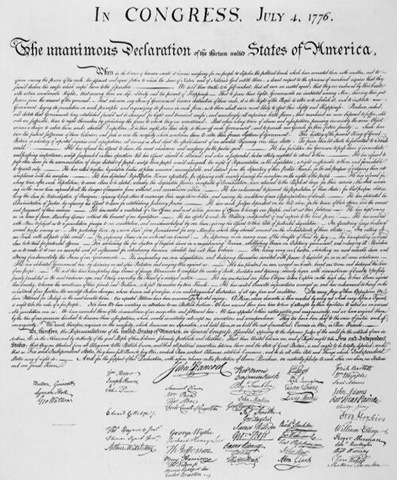 a clearly written charter that articulated the shared goals of an entire nation. The power of these goals set into motion a series of events that survive today.
Our Founding Fathers wrote the book on Change Leadership. Their collaboration through the difficult negotiations required to build the consensus for an organizational change of immense magnitude is an example to all of us today.
Leading large scale change demands bold, courageous action. Action that can only be initiated and sustained by a clear set of shared goals, the Framers had one awesome set of organizing principles and a shared goal that demanded complete commitment to success.
As we get ready to enjoy the barbeques, fireworks and general merry making that comes to these United States each July 4th it’s crucially important to remember that we, as Americans, hold a sacred trust to remain faithful to the power of embracing change in an increasingly chaotic world.
I encourage everyone to take a minute this weekend to read the text of the most historic change charter ever written http://www.ushistory.org/Declaration/document/index.htm
Happy Independence Day!
Sick or Healthy. What’s your excuse?
When Edelman published its 2008 Trust Barometer in January the verdict was clear “trust no-one”. The lowest score of overall trust in both industry and government Edelman every recorded.
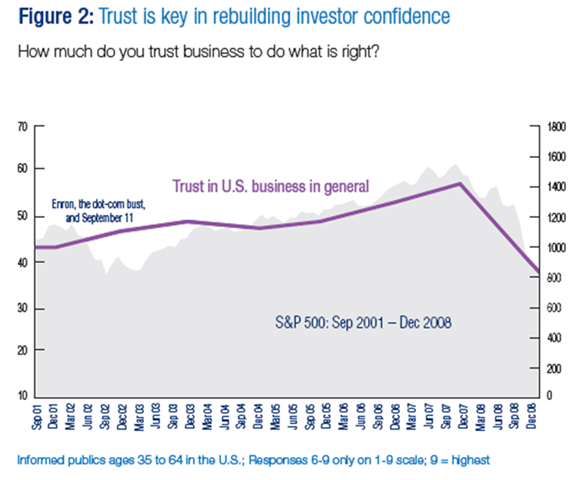
It got my attention and over the first half of 2009 I’ve discussed the issue of trust with clients many times garnering their opinions of how they feel about themselves and how their customers and suppliers feel about them.
What I hear confirms the Edelman findings. That personally and professionally we all follow the “trust and verify” philosophy of dealing with relationships these days. Trust is at the core of any relationship. With trust flagging it clearly follows that relationships are at risk. Relationships within our organizations and with key external stakeholders. Manifestations of the trust gap are sales cycles that take twice as long to close, payables that are consistently outside agree upon contracts, rumors of impending doom within the walls and overall low levels of valuable productivity.
Organizational health can be measured and trended. I advocate aggressively pursuing the development of a trust gap metric for all my clients. It’s relatively easy to establish since most of the key metrics already exist in most organizations but are seldom brought together in a single measurement. Consider that you presently collect customer satisfaction metrics, employee satisfaction metrics, vendor relationship metrics, shareholder value and some level of social media “buzz” analysis. Bringing all these individual measures of organizational health together in an index or total score allows any business to baseline health and trend it on a holistic basis.
Conventional wisdom and a plethora of research tells us that engaged employees build relationships and trust with customers and suppliers. High levels of integrity, ethics and transparency build confidence with investors and the communities we work in. All of this wisdom then begs the question, why isn’t this something we should trend?
My task for business leaders is to pay attention to the trust gap. Financial pressures are often convenient excuses for violating the trust of key stakeholders. Holding payments to suppliers beyond 60 days, violating sales agreements, paying bonuses to senior executives while the rank and file are denied merit increases are all excuses we use to violate trust slowly eroding relationships.
In the words of Peter Drucker “Business ethics assumes that for some reason the ordinary rules of ethics do not apply to business”
If this is your operating model you are in the midst of a serious trust gap.
Re-evolution Has Begun
Up, up, up…a little anyway. Our global economy is beginning to eak its way up the hill and businesses are responding by poking their corporate heads up.

What I see happening in the marketplace is executives opening their doors, peaking out the window and taking small steps towards their “renewed” organizations. Dealing with the rapid pace of the changes that have taken place demands a strong “constitution” as my father would say. Many organizations did the duck and cover maneuver holding tight and pulling in every appendage to weather the historic economic storm.
Changes in the marketplace are here to stay, organizations are just now initiating their actions to renew and emerge as a re-evolved entity. Realizations that global forces have changed, last year’s operating model is dead and new operating models must emerge are just now taking hold. I have often talked about Organization Renewal in this blog and with my clients. Most have had a bit of a tin ear. Now’s the time to get a hearing aid fitted and listen up or be left behind.
Renewal begins with defining the possible, discarding old ideas of what was and look forward to what will be. I read a piece today in ESPN The Magazine talking about a 16 year old from Southern California, Zac Sunderland, that embarked on a solo circumnavigation of the globe. He’s very close to hitting home port in Marina Del Rey. What struck me was this observation “people in ports always asked me where I was going next, not where I’ve been”. This is the key to renewal. Look to the next horizon.
In the world of business change it’s about defining the picture in vivid term of what will be. Bringing together the organization and enrolling each and every individual in that vision.
My challenge to every business leader is to ask yourself this question every morning before you pop that first e-mail “Where am I going next?”
Happy adventuring!
About The Change Dude
Outside the blogoshpere I’m Bob Caruso, a professional change artist/Managing Partner at Orchid Black.
Most people don’t particulary like when things around them are constantly challenging their ability to walk in a straight line. I, on the other hand, love it when the status quo was 10 minutes ago. Over the past 30 years I’ve been assisting people and organizations reinvent, reinvigorate and renew themselves. It’s a blast!
On a more professional note…I bring 35 years experience in implementing large scale change as both an executive and professional consultant. Through that time I’ve carried business cards for some formidable firms including Rockwell, Price Waterhouse, Deloitte and J.D. Power and Associates. For more about my professional history visit http://www.linkedin.com/in/bobcaruso.
Visit me here to get the opinions, advice and connections you may be looking for when the string in your life gets a bit kinky.
-
Recent
- Does Innovation Remain at Risk
- AI and the Complex Sale
- The Power Play of ‘Let Me Finish’: Strategies to Foster Open Dialogue
- Navigating Life’s Unkown Journey
- Chief Digital Officer (CDO) The What’s and Who’s
- Digital Transformation:Erecting the House
- Digital Transformation: Real or Marketing Jargon?
- The Price is Right: Cracking the Code of Productivity
- Disaster Communications
- Professional Certifications: Who Cares?
- The Age of the Itinerant Professional
- Wisdom versus Knowledge in the Age of AI
-
Links
-
Archives
- January 2025 (2)
- December 2024 (1)
- November 2024 (3)
- October 2024 (3)
- September 2024 (3)
- August 2024 (4)
- July 2024 (3)
- June 2024 (2)
- May 2024 (5)
- April 2024 (4)
- March 2024 (4)
- February 2024 (2)
-
Categories
-
RSS
Entries RSS
Comments RSS
 The Change Dude's Blog