Chief Digital Officer (CDO) The What’s and Who’s

Digital transformations don’t happen all by themselves. Over the past decade as digitization of the enterprise has taken hold a new C-Level role has been appearing, the Chief Digital Officer.
The term “Chief Digital Officer” (CDO) started gaining traction in the early 2010s. According to Gartner, a leading research and advisory company, the CDO role was predicted to become a “hot executive title” by 2012, and they forecasted that by 2015, 25% of organizations would have a CDO. As is often the case, adoption predictions take longer to materialize than is thought. According to research from PwC, about 21% of large public firms now have a CDO. A little short of the 25% number predicted for 2015 but still a significant presence in the board room.
CDO’s play a crucial role in modern organizations, spearheading digital transformation efforts essential for businesses to remain competitive in today’s fast-paced, technology-driven world. The importance of the CDO lies in their ability to integrate digital technologies into every aspect of a company’s operations, driving enhanced efficiency, improving customer experiences, and unlocking new revenue streams.
What does a CDO do? CDO Role and Value
Driving Digital Transformation: At the heart of the CDO’s role is the responsibility to drive digital transformation across the organization. This involves not just implementing innovative technologies, but also rethinking and redesigning business processes to use digital capabilities fully. This transformation is essential for companies to stay relevant in an increasingly digital economy, where traditional business models are continually being disrupted by innovative digital solutions.
Enhancing Customer Experience: The CDO is tasked with improving the customer journey by using digital tools to provide seamless, personalized experiences. In a world where customer expectations are at an all-time high, businesses must deliver consistent, high-quality interactions across all digital touchpoints. The CDO ensures that the organization is equipped to meet these expectations by integrating customer data, leveraging artificial intelligence, and employing user-friendly digital interfaces.
Optimizing Operations: Digital transformation is not just about customer-facing changes; it also involves refining internal operations. The CDO works to streamline workflows, reduce inefficiencies, and improve decision-making through data analytics and automation. This can lead to significant cost savings and enhanced productivity, providing the company with a competitive edge.
Fostering Innovation: A critical aspect of the CDO’s role is to foster a culture of innovation within the organization. This involves encouraging experimentation with modern technologies, supporting digital initiatives, and promoting a mindset of continuous improvement. By driving innovation, the CDO helps the organization to stay ahead of technological trends and respond quickly to market changes.
Ensuring Cybersecurity: As businesses become more digitally integrated, the risk of cyber threats increases. The CDO handles implementing robust cybersecurity measures to protect the organization’s data and digital assets. This includes ensuring compliance with data protection regulations and fostering a culture of security awareness among employees.
What does a CDO look like? Typical Profile
Technological Smarts: A successful CDO must have a deep understanding of various digital technologies, including cloud computing, artificial intelligence, data analytics, and cybersecurity. This technical knowledge allows them to find and implement the right digital solutions for the organization.
Strategic Vision: The CDO should have a strong strategic vision to drive the digital agenda. This involves understanding the broader business context and aligning digital initiatives with the company’s overall goals. The ability to think long-term and anticipate future technological trends is crucial.
Leadership Skills: Effective leadership skills are essential for a CDO, as they must inspire and motivate the organization to embrace digital change. This includes leading cross-functional teams, managing resistance to change, and fostering a collaborative environment.
Business Acumen: The CDO needs a solid grasp of business fundamentals to ensure that digital initiatives deliver tangible business value. This includes understanding key performance indicators, financial metrics, and market dynamics.
Change Management: Driving digital transformation often involves significant organizational change. The CDO must be adept at managing this change, including communicating the benefits of digital initiatives, training employees, and ensuring a smooth transition.
Final Thoughts
The role of the Chief Digital Officer is pivotal in navigating the complexities of the digital age. By driving digital transformation, enhancing customer experiences, optimizing operations, fostering innovation, and ensuring cybersecurity, the CDO helps organizations to thrive in an ever-evolving technological landscape. What I find interesting is that in collaborating with my clients over the past decade since the inception of the CDO title I’ve never run into that role in any of my clients. It’s most often a project specific role that fills that space working with the C-Suite versus being a member of it. I’m looking forward to seeing the continued expansion of the role in all organizations over the next few years.
Digital Transformation:Erecting the House

The Challenge
In my last installment I discussed building the foundation for Digital Transformation. It’s time to erect that digital house on the strong foundation of business alignment that’s been poured and the clean-up of software debris completed. Adoption of new tools and processes always, and I mean always, represent the highest hurdles any enterprise must overcome to achieve digital transformation. Just a reminder that 38% of spend on these projects DO NOT mee their ROI objectives. So, 38 dollars or every 100 spent gets flushed into oblivion. In my experience that number is often higher but unrecorded.
Focus on Adoption
In my neighborhood a home built in the 1980’s has been undergoing a massive renovation, it’s been nearly 2 years since the whole process started. We were all very glad to see the changes, at first. To say that the neighbors are over-it is an understatement. Trucks everywhere blocking the street, a never-ending stream of contractors, noise and distraction have made all of us less than excited about the outcome, we just want it OVER! It’s the same phenomenon with digital transformation projects, employees see the value when the work begins but over time if the distraction of the change overshadows the intended outcome interest wanes and resistance builds. Consider that on any given day over 60% of employees are frustrated by new technology implementations. Successful digital transformation efforts understand this challenge and plan to reduce the risk.
Adoption Critical Success Factors
- Modernize Processes
- Redesign the business processes impacted by the change BEFORE implementing the digital tools. Never hope that the technology will change the processes by default.
- Work closely with key influencers in the process areas impacted to understand the work and build confidence that the technology improvements with make their lives easier and more productive.
- Memorialize the modernized processes on paper. Yes, on paper. Despite the notion that no one reads paper, employees want to see their new processes in front of them to understand, review and provide feedback.
- Design a Unified User Experience
- One password, one landing page, a unified experience that allows employees easy access to the new technology experience. There is no bigger mistake than to add passwords and landing pages to the already overloaded technology stack.
- Unified experiences that clearly mechanize the modernized processes give users the confidence needed to dive in and build competency. Forcing users to navigate new paths on top of old paths will make time to value increase significantly.
- Engage, Engage, Engage
- Introducing digitally transformed processes requires time and effort in engagement with the impacted employees. Build that time into the roll-out calendar. Shorting the initial adoption period is the biggest miss I see most often.
- Ensure senior leadership and process influencer involvement early and often.
- Focus on the WIIFMs (What’s In It For Me) value in every conversation. Users really don’t care much about the “bigger picture” value the digitization will produce; they focus on how it helps them do their job faster and easier. Unless everyone in the business owns stock in the company shareholder value is a poor WIIFM.
- Measure Adoption Religiously
- Observe usage regularly. Regularly depends on the process being performed some processes occur daily, others monthly or even less often, build a measurement scheme that takes these periods into account.
- Digital observation is only one way to measure adoption, it’s often the least reliable method. Digital monitoring will only provide a signal that adoption is weak, physical observation and measurement offers stronger data to assist users in adoption.
- Recognize Early Adopters
- Positive reinforcement of early adoption through highlighting success stories builds momentum for the changes implemented.
- Publicize stories about how customers are served more quickly and accurately than ever before or any other positive outcomes from early adopters.
Closing Thoughts
Digital transformation with embedded artificial intelligence is underway across the business community. Massive investment in digital technologies only produces the desired outcomes when these technologies become institutionalized as leading practice in your business. Be mindful of the positive steps you can take to reduce the risk of failure by planning carefully and executing flawlessly.
The Price is Right: Cracking the Code of Productivity

Leading a highly productive organization—that’s every executive’s dream, isn’t it? But here’s the catch: it’s like herding cats. I mean, have you ever tried to herd cats? Exactly.
In my line of work, productivity issues pop up like whack-a-mole. Weak leadership, lousy tools—you name it. Clients think tech can magically fix these bumps and potholes on the productivity road. Some even go all out on training programs, as if a few webinars will turn Bob from accounts into Steve Jobs. Spoiler alert: it won’t. Enter Price’s Law.
Understanding Price’s Law: The Square Root of Productivity
Price’s Law—the square root of productivity. Sounds fancy, right? Derek J. de Solla Price, who probably had too much time on his hands, came up with this in ’65. He basically said that if you have 100 employees, about 10 of them will do half the work. So, next time you’re in a meeting with 100 people, look around. Ten of them are actually doing something. The rest? Well, they’re probably forwarding memes.
This isn’t just office gossip. It’s everywhere! Academia, business, creative industries—yep, same story. It’s like we’re all part of one big, inefficient sitcom.
Then there’s the Pareto Principle—the 80/20 rule. It’s like Price’s Law’s less nerdy cousin. It says 80% of the effects come from 20% of the causes. Both say productivity is uneven, but Price’s Law is more like, “Hey, let me give you a precise math equation to show you just how much everyone else is slacking off.”
The Origins of Price’s Law
In the 60s, Price noticed that a few scientists were making most of the significant contributions. So, while everyone else was pretending to read their emails, these folks were doing all the actual work. Thus, Price’s Law was born and applied everywhere. Sales teams, coding departments, universities—you name it.
Organizational Structure Implications
Businesses can learn a thing or two from this. In a sales team of 100, about 10 people will close half the deals. The rest are probably just updating their LinkedIn profiles. Managers should identify their top performers and maybe, just maybe, reward them. Shocking idea, I know.
As companies grow, the number of genuinely productive people doesn’t keep pace. You end up with more dead weight, and things slow down. So, the key is to create an environment that keeps those top performers happy. Maybe don’t give them an open-plan office right next to the kitchen, yeah?
Real-world examples? Sure. In a research lab with 100 scientists, about 10 will come up with the groundbreaking stuff. The rest? Well, someone’s gotta make the coffee. In a tech company with 200 developers, about 14 will write the code that actually matters. The rest are probably arguing over tabs vs. spaces. In academia, out of 40 professors, around 6 will publish the papers that get all the citations. The rest are perfecting their PowerPoint animations.
Critics argue that Price’s Law simplifies complex human behavior. No kidding! But, even with its flaws, it’s a handy way to understand productivity.
Take Aways
Price’s Law offers a compelling perspective on productivity and performance within groups. By recognizing that a small number of individuals often drive a significant portion of the results, organizations can better allocate resources, identify top performers, and create environments that foster high performance. While it is not a one-size-fits-all solution, Price’s Law provides a valuable framework for understanding and refining productivity in various domains.
So, takeaway time: Price’s Law tells us that a small group often drives the bulk of the results. Spot these people, reward them, and don’t let the other ones drag the whole thing down. Easy, right? Well, it’s a start.
The Age of the Itinerant Professional

White collar professional employees in the U.S. have become itinerant workers over the past 20 years. We would typically use this term in relation to seasonal workers like fruit pickers, construction workers or ski instructors, someone who travels from place to place to find work, typically for short periods. These workers seldom have a permanent residence and move frequently to follow job opportunities. Does this sound familiar? Can you relate?
In working with my clients, it’s not unusual to find high tenure employees on the cusp of retirement mixed with lower tenure staff. The higher the tenure the higher the competency in their role and more innovative response to business challenges.
A variety of factors have prompted the rise of these itinerants:
- Decreasing Median Tenure: Over the past two decades, the median tenure for white-collar workers has remained relatively low, around 4.1 years. Let’s break this down and estimate it takes about 9 months to get integrated into the new organization and around 6 months to find a new job which leaves real effective tenure at 2.5 years.
- Increased Job Mobility: The labor market has seen significant changes, with more opportunities and a higher rate of job switching. Economic conditions, such as the strong labor market in recent years, have encouraged employees to seek better opportunities, leading to shorter tenures.
- Changing Career Expectations: Modern professionals often prioritize career growth, skill development, and work-life balance over long-term loyalty to a single employer. This shift in career expectations has contributed to more frequent job changes as employees seek roles that better align with their personal and professional goals
- Impact of Technology and Remote Work: Advances in technology and the rise of remote work have made it easier for employees to transition between jobs and even industries. This flexibility has reduced the barriers to job mobility, allowing white-collar workers to explore new opportunities more readily.
- Economic and Industry Shifts: Economic downturns, such as the 2008 financial crisis and the COVID-19 pandemic, have led to layoffs and restructuring in many industries. These events have forced many professionals to change jobs more frequently, contributing to the perception of white-collar workers as itinerant.
This itinerant trend of white-collar professionals frequently changing jobs has several negative impacts:
- Career Development Challenges: Employees who frequently change jobs find it harder to develop deep expertise in a particular area. Research suggests that to reach mastery in a competency 20,000 hours are required. Average tenure of 4.1 years in a role is less than half those hours. This can impact their long-term career growth and advancement opportunities.
- Weak Job Security: Frequent job changes can lead to a sense of instability and insecurity among employees. This can be particularly stressful during economic downturns or periods of organizational change.
- Reduced Employee Loyalty: Companies may struggle to build a loyal workforce. High turnover rates can disrupt team cohesion and make it difficult to maintain a consistent corporate culture.
- Increased Recruitment and Training Costs: Organizations may face higher costs associated with recruiting and training new employees. This can also lead to a loss of institutional knowledge and expertise.
- Impact on Mental Health: Constantly adapting to new roles, environments, and expectations can lead to increased stress and burnout. The pressure to continuously prove oneself in new positions can be mentally taxing.
- Disruption of Work-Life Balance: Frequent job changes can disrupt personal lives, making it harder to establish a stable work-life balance. This can affect overall well-being and job satisfaction.
These downsides highlight the importance of finding a balance between job mobility and stability to ensure both employee well-being and organizational effectiveness.
It’s not easy to please the itinerant professional. However, there are a few tips to reduce job hopping and increase retention in your organization.
Table Stakes:
- Positive Work Environment: Foster a supportive workplace culture where employees feel valued and respected. This can enhance job satisfaction and loyalty.
- Competitive Pay and Perks: Ensure that salaries and benefits are competitive within the industry. This includes health benefits, retirement plans, and other perks that can make employees feel more secure and appreciated.
- Employee Engagement: Regularly seek feedback from employees and involve them in decision-making processes. Engaged employees are more likely to feel connected to the company and less likely to leave.
Big Bets:
- Hire the Right Fit: During the recruitment process, look for candidates who align with the company’s values and culture. Employees who feel a strong connection to the company’s mission are more likely to stay long-term.
- Invest in Employees: Invest in employees’ growth by offering training programs, workshops, and opportunities for career advancement. This helps employees feel that they are progressing in their careers and gaining valuable skills.
- Employee Retention Programs: Develop programs that recognize and reward long-term employees. This could include bonuses, additional vacation days, or other incentives for staying with the company.
- Promote Work-Life Balance: Promote policies that support a healthy work-life balance, such as flexible working hours, remote work options, and adequate paid time off. This can reduce burnout and increase job satisfaction.
Employees often move on when they feel underappreciated, bored by the work or unhappy with their direct leadership.
Take a moment and evaluate what it would take to keep you at a business for 7 years or more.
Paranoia: The Foundation of Business Agility

North American Aircraft (NAA)produced around 42,000 aircraft during World War II that included the iconic P-51 Mustang and B-25 Mitchell bomber. employing over 90,000. At the conclusion of the war effort then company president James “Dutch” Kindelberger had a business problem. What do we do now? The P-51 and B-25 lines were shut down. He put his executives to work to build a new, innovative business. The results were astonishing with NAA developing the F-86 Sabre, the first military jet as well as other jet aircraft based off the Sabre technology.
I tell this story only to illustrate how quickly a business model can experience dramatic change overnight. I had the honor to work at NAA for several years following the end of the Cold War when a similar dramatic transition occurred. We would often raise Dutch as the model for embarking on a new, innovative era following the B-1 Lancer and Space Shuttle contracts expiration.
Are you prepared to adapt at a moment’s notice? Do you have agility built into your business model and organization? Can you adapt or will you die?
Business agility is crucial for organizations to respond to market changes and emerging opportunities quickly and effectively. Dutch Kindelberger was a leader that made change happen at NAA through his hands-on style and a strong focus on innovation and efficiency.
Here are the key components that make up business agility:
- Leadership: Agile leadership focuses on communication, collaboration, and commitment. Leaders develop others as leaders and work towards a shared purpose1.
- Governance: Effective governance ensures that decision-making processes are flexible and responsive to change. It involves setting clear guidelines and frameworks that allow for quick adaptation1.
- People: The workforce must be skilled, adaptable, and empowered to make decisions. Continuous learning and development are essential to maintain agility1.
- Culture: An agile culture promotes innovation, risk-taking, and a willingness to adapt. It encourages a mindset that embraces change and values continuous improvement1.
- Strategy: Agile strategies are dynamic and flexible, allowing organizations to pivot quickly in response to new opportunities or threats. This involves regular reassessment and adjustment of strategic goals1.
It’s easy to lay out the pieces required for business agility and the challenges to pull it off are numerous. Everything from our old friend resistance to change to the mechanics of having flexible processes.
In my experience, agile organizations are always in a state of change. Every planning cycle promotes investment in innovation. Andy Grove, the former president, and CEO of Intel, was famously known for the mantra, “only the paranoid survive.” Being paranoid isn’t a bad thing, it keeps us looking forward, not accepting the status quo as lasting forever.
A couple of tips to think about:
1. Always have an eye beyond the next 24 months. Look beyond the end of your desk calendar for possible disruptions and innovations.
2. Take succession planning seriously. Succession planning is not just for the most senior leaders in the business, it’s a process that should evaluate talent at all levels of the organization for either new opportunities or skill building.
3. Be honest and accountable. Be honest with yourself about the state of your business model and accountable for goal achievement. Don’t allow yourself to get comfortable or complacent.
4. Make changes in the business part of the business. Change is the only constant in life, make it part of doing business every day. Changes may be small but making it a norm in the culture will pay dividends.
Be paranoid…in a good way!
Customer Focused Change…Do it!

Nearly every survey done over the past 30-some-odd years asking about why large scale technology or process improvement projects fail indicates a weakness in change management. Hmmm..Isn’t that interesting. A recurring failure point. Why? Why is managing change such a challenge? In my mind and experience the answer is quite simple. A weak connection to the change’s impact on customers.
Every process improvement guru focuses on understanding customer wants, needs and perceptions before embarking on any business intervention. Improve efficiency, implement new technologies, bring a new product to market, change pricing and packaging, you name the change it should always be underpinned by driving customer retention and/or acquisition. Yet, when I walk into a client situation and ask a simple question about customer metrics the change will impact, I get blank stares. When I ask a Six Sigma Black Belt what the CTQ’s (Critical to Quality) are that made this effort important I get the same result, a thousand-mile stare. And we wonder why employees don’t adopt new practices or technology.
In my earliest interactions with any client the customer is always a topic. How will this change impact the customer’s wants, needs and perceptions? Will it make you easier to do business with? Will your employees be engaged with the change because they know how it will affect customer satisfaction? Very few clients can answer these questions. Very few consultants working on the change can answer these questions. Hence, all the communication and training in the world won’t make adoption happen or the change stick.
CUSTOMER FOCUSED CHANGE: A PRIMER
DEFINITION: Customer-focused change is a strategic approach where businesses prioritize the needs and experiences of their customers in every aspect of their operations. This involves a shift from product-centric to customer-centric thinking, where the ultimate goal is to enhance customer satisfaction, loyalty, and advocacy.
Imagine!! Putting the folks that pay the bills at the center of the universe. What a strange concept.
A FEW TIPS
Here are some tips on exercising customer-focused change:
Understand Customer Needs: Understand clearly the wants, needs and perceptions of your customers.
Align with Customer Success: If you want a sticky change align your success with that of your customers, ensuring that all facets of the change prioritize the impact on customer wants, needs and perceptions. Don’t be fooled by thinking you know what the impact will be, know if well enough to measure against.
One of my favorite stories is about a client I worked with to improve their ease of doing business by implementing a new ERP solution. On a customer visit we asked what would make their experience better with the client. The answer was both hilarious and sad. “If we knew before the FedEx truck drove past the dock we weren’t getting our shipment today.” That’s big. We turned that story into a primary message for the change. Making sure the investment in time and money wasn’t focused on just hitting a go-live date but on giving that customer and others transparency to their order status.
Prioritize Customer Feedback: Take all customer feedback seriously. Make decisions with that feedback in mind. One of my clients painted on the wall of their main conference room these words: “How will this impact our customers?” At every meeting about the change project the leadership team would point to that question when being asked to decide on a modification to the project.
Operationalize Customer Empathy: Make it real! Implement practices that operationalize empathy towards customers. Add technology where appropriate to aid in understanding and meeting their needs more effectively. Change should not be just about reducing costs, which it often is, but about reducing operating costs while improving the customer experience.
Engage Employees: Link the change message internally to customer outcomes. Employees really do care about their customers, they want to know how this change will make customers more loyal to the brand and keep their jobs safe.
Exercising customer-focused change, may require businesses to adjust change strategies, processes, and even their organizational structure to ensure that customer needs are at the forefront of decision-making.
Put customers at the center of any change and watch the success rate of adoption increase dramatically.
Are you a chicken or a pig?

Chickens and pigs, both wonderful animals that contribute to healthy, delicious breakfasts all over the world. Many years ago, when I was a young professional, one of my mentors would tell the story of breakfast. It goes like this. When you look at your morning fuel plate it’s not unusual to see bacon and eggs sitting in front of you. Consider the contribution of the chicken and the pig. The chicken is involved in the meal by offering a fresh egg. The pig is committed to its involvement.
Which are you? Do you commit to change or are you involved? The difference is stark.
Chickens use words like buy-in and alignment to affirm that they’ll work to make a change successful. Soft words with soft meanings imply that you’re sort of going to do things that contribute to the goals of the necessary change. You’ll be involved in the work, but if the work gets too hard, maybe you’ll quit on the efforts. Chickens need multiple enticements to stay engaged and really work to achieve the stated goals. Chickens will move the goal posts of the change just to declare success. Most people involved in transformation programs are chickens. It’s just human nature to be cautious and leave options open.
Pigs on the other hand are all in. They use words like commitment and must do. Pigs put everything they have into the effort without enticements because they believe in the ultimate vision. Pigs don’t let obstacles move the goal posts. Pigs persevere through the challenges, make sacrifices, and never relent. Achieving the goals of transformational change sits at the top of their to-do list. Every change effort must have leaders that represent the characteristics of the pig. These are the change agents, the visionaries, the evangelists.
Imagine if every team member was committed to a change effort versus being involved. The success rate of change programs would skyrocket. Visions would be achieved at a higher rate and returns on investment goals would be beaten.
Just a few tips to garner commitment:
- Set clear goals for the change effort. Words to describe and metrics to achieve.
- Align incentives for goal achievement.
- Communicate expectations clearly. Achieving genuine commitment requires clear communication of expectations, goals, and responsibilities.
- Build a roadmap of actions together with all the stakeholders.
- Assign accountabilities for all actions with clearly defined results.
- Measure progress frequently adjusting as needed to maintain commitment.
THIRTY IS THE NEW TWENTY-ONE
Recently I’ve seen various pieces discussing why people don’t want to work anymore. Is that true?
When I review the articles, they offer a list of circumstances that drive the perception that folks don’t want to work. The reasons go from not enough pay to the rise of entrepreneurship. Really!
In my experience interacting with clients, local universities, and just plain folk I don’t get the impression people don’t want to work anymore. I do find that new graduates are much more selective about the roles and companies they choose to contribute their talents to for their work. As is commonly the case with media of any type, social or print, hyperbole rules the day.
Work drives self-confidence. Contribution to a cause or a goal in achieving a mission makes getting up every morning worthwhile. It’s just that these days young people want more than a paycheck. They have been so accustomed to the abundance of their childhood there’s a feeling that things continue status quo forever.
I was chatting with a group of young associates the other day and they all were focused on discussing their next adventure in an exotic location or their personal fitness goals and preferred diet. Of course, in their late 20’s none is married or has children. Most live in rented apartments and drive older vehicles. So, I commented to them that the age of thirty is the new twenty-one. Boy was there an uproar. “What do you mean?” Well, being a baby boomer, the answer was clear. At the age of thirty most of my generation had a family, a mortgage, two cars, and had never been to Borneo on holiday.
The point here is that the impression that no one wants to work anymore is driven by the reality that work is a sideline to life for the generations succeeding baby boomers. While boomers, like me, are in the waning stages of dedicated work lives. Hence, employers find it challenging to hire and retain a consistent workforce.
Culture, as described by language, rituals and artifacts of a civilization are changing in our time. No longer are the rituals of marriage and family associated with youth. The artifacts of success have changed from material wealth to a wealth of experiences and selfies. The language of work has been replaced by the language of health, fitness, and travel.
Employers must be aware of the cultural change and adapt appropriately.
- Clearly articulate the underlying mission of your organization so aspiring employees know what to expect.
- Offer multiple accession tracks with off-ramps to accommodate a stop-out period for travel or mid-career maternity/paternity.
- Be open to the virtual vagabond employee through planning where new hires may have an on-premises work requirement for a determined period before remote options are available.
- Purposefully create cultural norms that represent the business to both internal and external stakeholders.
This cultural change is a tough nut for management. It’s a 180-degree flip from what we as a culture have been accustomed to for over a century. It’ll take time and effort to achieve the productivity desired of employees while meeting their intrinsic needs. Remember our friend Maslow? Today’s workforce places self-actualization achievement over basic needs, they assume they will have their basic needs met somehow.
Selling Air

I’ve been selling air my entire business life. Having never been a hard goods or software seller the ability to sell a vision to clients is essential, it’s like selling air—intangible.
From my earliest days of developing business in the aerospace and defense world where I was selling a vision of the latest and greatest flying machine, yet to be built, to the selling of a new business strategy. Selling a vision of what can be requires skill, strategy, and a deep understanding of the client’s needs and desires.
Just as air is vital for life, a compelling vision is crucial for the success and growth of any business. When I used the phrase ‘selling air’ with my associates recently they chuckled a bit and blew me off. So, I thought it would be a good time to explore the parallels between selling a vision and selling air.
Air is everywhere, yet we only notice its importance when it’s absent or smells bad. Similarly, a clear, inspiring vision may not be immediately apparent to clients, but its absence can lead to stagnation or failure. To sell air, it begins with first making clients aware of its value and the benefits it provides. Similarly, selling a vision requires you to articulate its benefits clearly and convincingly.
One of the challenges of selling air is that it’s invisible and intangible. Similarly, a vision is often abstract, making it challenging to communicate its full impact. Overcoming this challenge, requires skilled and compelling storytelling coupled with vivid imagery to make your vision come alive for your clients. Help them visualize the future you envision and how it will positively impact their lives or businesses.
Similarly, the selling of a vision and selling air requires a tailored approach to different clients. Just as different people have different needs for air (e.g., athletes need more oxygen than sedentary individuals), different clients have different needs and priorities. When selling a vision, take the time to understand each client’s unique challenges, goals, and aspirations, and tailor that vision to address their specific needs.
Just as air quality can vary based on location and environment, the quality of your vision can vary based on how well it aligns with the client’s values and objectives. Ensure that your vision is not only compelling but also relevant and aligned with the client’s long-term goals.
Selling air requires trust. Clients must trust that the air you’re selling is clean and safe to breathe. Clients must trust that your vision is achievable and will deliver the promised benefits. Build trust by providing evidence, testimonials, and examples of how your vision has worked for others.
As essential for life is air, a compelling vision is essential for inspiring and motivating action. Your vision should not only be aspirational but also practical and actionable. Clearly outline the steps required to achieve your vision and the expected outcomes.
Living in the world of intangible selling can be both frustrating and glorious. Facts, figures, and features have no place here. Deep data only confuses the vision and distracts from the story.
Succes begins with showing the value of the future, constructing a compelling story to bring it to life that means something deep in the client’s soul. What is it that excites them about their personal future? About the future of the business? Achieving the visceral commitment to achieving the vision demands alignment with their values and goals, a bond of trust, and a clear roadmap for achieving the vision.
Go ahead and sell some air, it’s essential for life!
Coming Soon! Beware the Shiny Object
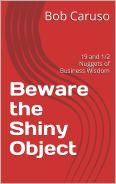
I’ve been working on a book since the start of the new year, although it’s been about 30 years in research. The content is complete and final editing is in progress with a release date within the next 30 days. So excited!
Every business leader could use a bit of advice occasionally. In this book, I share 19 and ½ Nuggets of Business Wisdom accrued from the last 35 years under the covers of all types of businesses. Whether you’re a software developer or leading a multi-million-dollar manufacturing business, this book has something for you. Every business leader looks for concise honest insights with clear actions. This book delivers.
Topics of interest include strategic decision making, organization transformation, program management, team building, customer engagement and others. With each nugget I highlights traps that can be set and practical tips to avoid them highlighted by real world case studies.
You’ll find each nugget either thought provoking or strangely familiar.
Over the next few weeks I’ll post snippets of the book to this site.
About The Change Dude
Outside the blogoshpere I’m Bob Caruso, a professional change artist/Managing Partner at Orchid Black.

Most people don’t particulary like when things around them are constantly challenging their ability to walk in a straight line. I, on the other hand, love it when the status quo was 10 minutes ago. Over the past 30 years I’ve been assisting people and organizations reinvent, reinvigorate and renew themselves. It’s a blast!
On a more professional note…I bring 35 years experience in implementing large scale change as both an executive and professional consultant. Through that time I’ve carried business cards for some formidable firms including Rockwell, Price Waterhouse, Deloitte and J.D. Power and Associates. For more about my professional history visit http://www.linkedin.com/in/bobcaruso.
Visit me here to get the opinions, advice and connections you may be looking for when the string in your life gets a bit kinky.
-
Recent
- Does Innovation Remain at Risk
- AI and the Complex Sale
- The Power Play of ‘Let Me Finish’: Strategies to Foster Open Dialogue
- Navigating Life’s Unkown Journey
- Chief Digital Officer (CDO) The What’s and Who’s
- Digital Transformation:Erecting the House
- Digital Transformation: Real or Marketing Jargon?
- The Price is Right: Cracking the Code of Productivity
- Disaster Communications
- Professional Certifications: Who Cares?
- The Age of the Itinerant Professional
- Wisdom versus Knowledge in the Age of AI
-
Links
-
Archives
- January 2025 (2)
- December 2024 (1)
- November 2024 (3)
- October 2024 (3)
- September 2024 (3)
- August 2024 (4)
- July 2024 (3)
- June 2024 (2)
- May 2024 (5)
- April 2024 (4)
- March 2024 (4)
- February 2024 (2)
-
Categories
-
RSS
Entries RSS
Comments RSS
 The Change Dude's Blog