Self Service Off the Rails
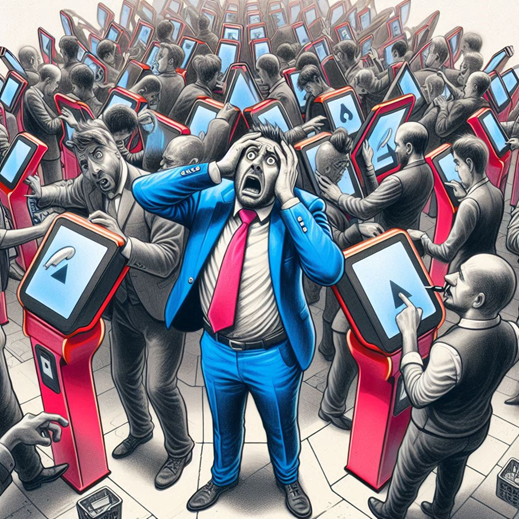
Yesterday I spent 2 hours climbing in my attic, crawling under sinks and behind toilets in service to my insurance company. Seriously? Apparently to save money my outrageously expensive insurance company decided that I should conduct my own self-inspection using a really shitty app providing them access to the perils of my toilet connections.
This is a version of self-service that is off the rails, out of bounds and an affront to the value I get from any insurance company. By the way, in over 4 decades of paying tens of thousands of dollars for homeowners’ insurance I have never filed a single claim, not one. The reward, go ahead and spend your time doing our job.
If this sounds like a rant, it’s because I’m angry and disappointed in how far businesses have taken self-service. Apparently, today’s business just provides a “thing” whether it’s a product or service they take no responsibility for actually serving their customers. Your app not working, try finding a human to help. Car breaks down and need a tow, you better have signal coverage and the app installed. I think you get the drift here. This all started when we began pumping our own fuel at service stations and has gotten wildly out of control.
I take some responsibility for these practices as a customer experience expert advising clients on how to both be efficient and customer focused simultaneously. Self-service is a tool in the bag but shouldn’t be the only tool.
I’m quite sick of having to download an app for everything in my life. From coffee shops to banking to utilities the world has gone application crazy. Data is the true commodity that every business is selling today, the insatiable appetite for more data has destroyed customer service. The thirst for personalizing every offer through the endless number of apps. On average we have about 35-40 apps installed on our smartphones. That means we carry between 35 and 40 cards in our wallet to conduct daily life. Imagine the size of your wallet. But since these cards are virtual and have no physical footprint, we don’t care, it’s just another icon on a screen.
I hope my point is clear, if a business wants to differentiate itself in a wildly competitive market take a stand and care for your customers with real-time support for your product and service. Self-service or Level Zero support is important for the mundane like password resets but don’t put customers into an endless loop of time wasting to access Level 1,2, and 3 support. Your customer’s time is just as valuable as your time, even more valuable as they pay your bills. Understand that one simple concept and you can differentiate.
There’s an App for That…

How many apps, a.k.a applications, do you have on your device? I bet you have no idea how many apps you carry around. I certainly don’t but I do know how many I use regularly, and the answer is about 5 or 6.
So, I did a little research using Bing Copilot and the findings were staggering.
The typical number of mobile apps that a smartphone user carry can vary, but here are some relevant statistics:
Monthly App Usage:
On average, a smartphone user accesses 30 mobile apps in a month, which translates to roughly 10 apps every day.
App Store Availability:
Apple’s App Store boasts a staggering 1.96 million apps available for downloads.
Google Playstore, catering to Android users, offers an even larger selection with 2.87 million apps.
Frequency of App Usage:
Approximately 49% of people open an app more than 11 times a day.
Interestingly, 21% of individuals between the ages of 23 and 38 open an app more than 50 times in a single day.
These numbers represent just how dependent humans are on technology these days. There are nearly 3 million apps available to download. What do all these little pieces of software do, exactly?
As I’m having fun playing with app numbers let’s do a little more math.
Here’s a table that breaks down the estimated number of apps per category based on the total size of available apps at 2.87 million in the Google Play Store:
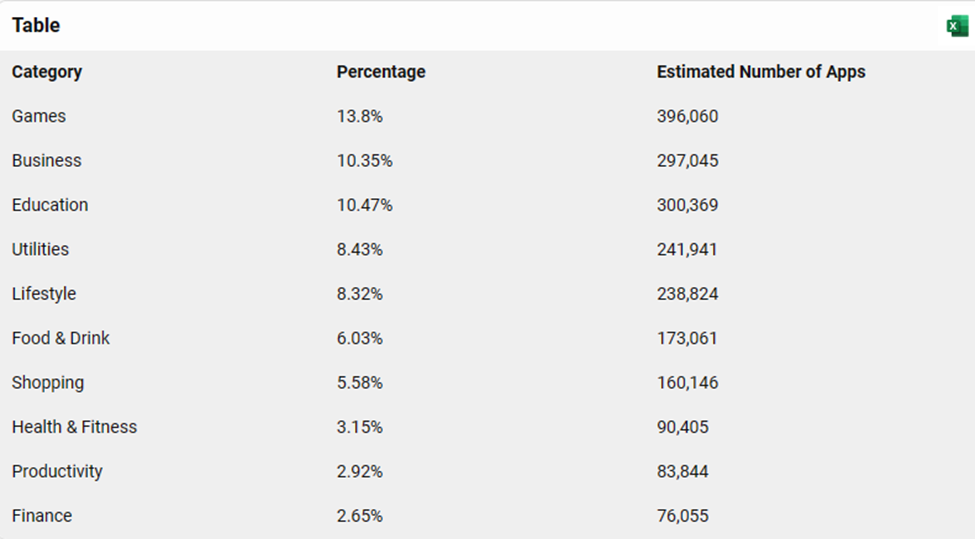
These figures are calculated using the percentages provided for each category and the total number of apps in the Google Play Store. Keep in mind that these numbers are estimates and can change as the app market evolves.
Not to be hyperbolic but this is CRAZY!!! 396,000 games, really? Nearly 300,000 business apps? Holy overload!
More fun with math, I asked Copilot to calculate the number of apps per person on Earth. Using the total number of app downloads and the global smartphone user count. As of 2024, there are 4.88 billion smartphone users worldwide1, and the total number of app downloads has reached 257 billion2.
Using these figures, we can estimate the average number of apps downloaded per smartphone user:
So, on average, each smartphone user has downloaded about 53 apps.
These numbers indicate a serious addiction to apps. So, if we take it from the top of this discussion where we saw that the average user accesses 30 apps per month with the potential to download 53 apps per month what is the point of all these technologies?
What’s the Value of Each App
I ask this question only to highlight the business issue of value. Where does the value lie for investors? How many new apps can be supported by the user community? There is no data available for the length of time that an app is viable in the marketplace, it may be years for some and weeks for others.
The average value of a mobile app can be determined by various factors, including its revenue, user base, and market demand. A common valuation method is to calculate the app’s value based on its average monthly revenue multiplied by a specified number of months. For instance, if an app generates $500 a month, it might be valued at 6 months’ worth of revenue, or $3,0001.
For apps that are post-revenue (already generating some income), a simple valuation formula could be:
Valuation=(CLV−CAC)×number of users
Where:
- CLV (Customer Lifetime Value) is the total net margin earned per user over their lifetime.
- CAC (Cost of Acquisition) is the cost to acquire a user.
This formula assumes the valuation is equal to the sum of all users’ average customer lifetime value minus their cost of acquisition2.
However, it’s important to note that app valuations can vary widely and are ultimately determined by what a buyer is willing to pay for it. Factors such as growth prospects, niche, and consistent revenue can influence the multiple used to calculate the final valuation. For example, an app generating $100,000 in net cash flow per year might be valued between $200,000 and $300,000, using a multiple of 2x to 3x3.
The cost of developing an app can also provide insight into its value. On average, building a mobile app can range from $100,000 to $500,000, with some feature-rich apps costing more than half a million dollars4
Be Diligent
Whether you’re a burgeoning founder of a new application offering or an investor looking for the next killer app you must be diligent.
- Research currently available apps in your category of interest.
- Determine the “white space” available, there isn’t much.
- Identify the functions users must have and those that will differentiate your offering.
- Develop an MVP (minimal viable product) quickly
- Test, test, test. Test the market, test the technology, test your resolve.
There will always be a market for the next “cool” app. Just be diligent before you spend mom and dad’s retirement fund.
About The Change Dude
Outside the blogoshpere I’m Bob Caruso, a professional change artist/Managing Partner at Orchid Black.

Most people don’t particulary like when things around them are constantly challenging their ability to walk in a straight line. I, on the other hand, love it when the status quo was 10 minutes ago. Over the past 30 years I’ve been assisting people and organizations reinvent, reinvigorate and renew themselves. It’s a blast!
On a more professional note…I bring 35 years experience in implementing large scale change as both an executive and professional consultant. Through that time I’ve carried business cards for some formidable firms including Rockwell, Price Waterhouse, Deloitte and J.D. Power and Associates. For more about my professional history visit http://www.linkedin.com/in/bobcaruso.
Visit me here to get the opinions, advice and connections you may be looking for when the string in your life gets a bit kinky.
-
Recent
- Does Innovation Remain at Risk
- AI and the Complex Sale
- The Power Play of ‘Let Me Finish’: Strategies to Foster Open Dialogue
- Navigating Life’s Unkown Journey
- Chief Digital Officer (CDO) The What’s and Who’s
- Digital Transformation:Erecting the House
- Digital Transformation: Real or Marketing Jargon?
- The Price is Right: Cracking the Code of Productivity
- Disaster Communications
- Professional Certifications: Who Cares?
- The Age of the Itinerant Professional
- Wisdom versus Knowledge in the Age of AI
-
Links
-
Archives
- January 2025 (2)
- December 2024 (1)
- November 2024 (3)
- October 2024 (3)
- September 2024 (3)
- August 2024 (4)
- July 2024 (3)
- June 2024 (2)
- May 2024 (5)
- April 2024 (4)
- March 2024 (4)
- February 2024 (2)
-
Categories
-
RSS
Entries RSS
Comments RSS
 The Change Dude's Blog